



If you’ve ever asked yourself, “How do I stop being codependent?” you’re probably tired of feeling responsible for everyone’s happiness except your own.
How to overcome codependency? The quick step-by-step answer is:
- Find out what needs your codependent tendencies satisfy to know how to replace them.
- Take care of yourself to build self-worth.
- Offer help only when someone asks for it.
- Accept that many things are outside your control (especially when it comes to other people).
- Set short, clear boundaries.
- Say what you want instead of expecting others to guess.
- Put yourself back at the center of your own life.
- Get support from a therapist or a support group.

How to Stop Being Codependent in a Relationship: 9 Steps
These nine steps show you how to stop being codependent in a relationship without turning to unhealthy relationship patterns.
1. Identify What Codependency Gives You
Codependency is a coping mechanism, and it gives you something you need. You wouldn’t have done it if your mind or body didn’t get anything useful out of it.
Once you know what that something is, it gets much easier to find a healthier way to get it. For example, these perceived benefits of codependency are the most common:
| What codependency can give to you | A healthier way to get it |
| Certainty and a sense of control | Practice radical acceptance. |
| Feeling needed and useful | Fulfill through your own projects and goals. |
| Approval and validation | Notice, name, and celebrate your own wins. |
| Protection from being abandoned | Give yourself the same kindness that you seek from others. |
| Meaning in life | Do things that you love and that feel important to you. |
| A sense of worth | Treat yourself well regardless of whether you did “good” or “bad.” |
2. Take Good Care of Yourself
People with low self-esteem are more prone to codependent behavior because they do not possess an internal sense of self-worth. It means that their opinion of themselves doesn’t matter to them. Unless this is negative self-talk, which they listen to because it confirms their self-image.
However, the need to have a sense of self doesn’t disappear. Hence, they must rely on external sources.
Self-care is non-negotiable for healthy self-esteem. Studies consistently prove that when people practice self-care, they start to believe they are worth the effort they put in [1] Healthy Lifestyle in Adolescence: Associations with Stress, Self-Esteem and the Roles of School Violence. A. González Moreno and M. del Mar Molero Jurado. Healthcare (Basel). 2023. .
If you’re wondering how to not be codependent, you have to rebuild self-esteem through what you do for yourself, not only what you do for others.

3. Only Offer Support When It’s Requested
Codependent behavior often comes from good intentions. For example, you might want your romantic partner to be the happiest, to skip all the suffering.
Unfortunately, sacrificing your own life for loved ones backfires. Extreme care can make you more resentful of a person. This doubles the suffering for both you and your partner, whom you wanted to protect.
“Does that mean that I can’t offer help or do nice things for my significant other?”
Of course, you can do nice things for loved ones. But not until they ask you for it. Instead of jumping in with solutions, you can ask:
- “Do you want advice, or do you want me to just listen?”
- “Would you like my perspective on this?“
- “Here is something that helped me when I was in a similar spot…“
- “Feel free to say no, but I can help you out in…“
Just keep in mind that your emotional resources are limited. If you spend them on problems nobody asked you to solve, it leaves very little for yourself. Stepping back may feel uncaring at first, but it’s how you stop codependent patterns from running the relationship.
4. Accept That Things Can Get Out of Hand
Codependent tendencies might arise from a need for control. Fear of abandonment and an anxious attachment style drive a person to manage the actions or problems of other people to feel safe.
Breaking free from the old habits is tough. Our brain is literally wired to explain everything and not accept the unknown. But the harsh truth is that the world is unpredictable. Events, other people’s choices, and future outcomes cannot be 100% controlled or calculated.
We will never fully know any person in the world besides ourselves. Who knows, maybe your coworker secretly hates you? Or your significant other could plan on leaving you. We can’t know anything for sure until we read their minds, which is impossible.
So, should you desperately seek reassurance? Should you work to prevent bad things from happening? Or could you learn to tolerate the short discomfort of uncertainty and trust yourself in the ability to deal with the future, no matter what it is? It’s your call.
If the worst happens, the earth will keep spinning, the sun will keep shining, and you’ll still be you.
“Tolerating uncertainty is a skill that can be learned at any age, even for people who grew up with unpredictable caregiving where staying alert felt necessary.
It builds through small, repeated practice: delaying a reassurance text, skipping one check of a partner’s location, and noticing that the anxiety rises, peaks, and passes without any action.
Mindfulness and ACT skills help people make room for the discomfort instead of fighting it, and self-compassion keeps the process from becoming another way to judge themselves. CBT approaches that target intolerance of uncertainty are well supported, and a therapist can help set the pace.”
5. Set Healthy Boundaries
Healthy boundaries tell people what you will and won’t do. If you’re trying to figure out how to break codependency, this is where you’ll feel the change most.
Setting boundaries is never about making it worse for other people. They are about your emotional well-being, taking care of yourself because it’s your job.
6. Stop Expecting Mind-Reading
Stop expecting the people you love to guess what you want. This is not their responsibility to guess. Our expectations and desires are our responsibility.
For you, anticipating someone’s needs before they say a word may feel like love. But that doesn’t mean it’s how they show love. Your close circle can add a lot to your emotional fulfillment, but the only person who can reliably know what you want is you.
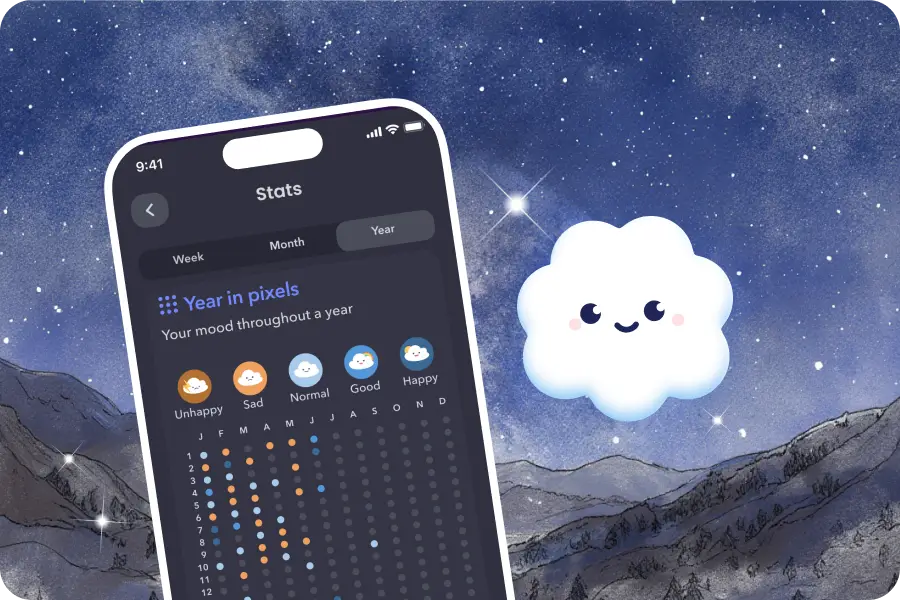
To say what you want, you first need to know it. Build self-awareness by practicing identifying your feelings a few times a day. You can do it with the mood tracking feature in the Breeze app, with a log that is always on your phone when you need it.
7. Re-Center Yourself in Your Own Life
Codependent individuals often center on the needs of their partners/family members while abandoning their own.
Rebuilding your sense of self doesn’t mean you have to forget who you were and start anew. You can simply start doing more of the things you genuinely want. Pick at least one thing that belongs only to you, such as:
- A class or skill you’ve wanted to learn.
- A side project.
- A weekly walk, workout, or coffee alone.
- A long-postponed goal, like saving for a trip.
- Time alone.
Make time to spend time alone, too. Being able to enjoy your own company while grounding yourself in the present moment is a skill. It gives you a sense of purpose outside the relationship.
8. Have an Honest Conversation with Your Partner
Codependency involves two people. Overcoming relationship addiction works best when you do it together.
The first step is to share your emotional needs and worries in an honest conversation. A few things make it easier:
- Pick a calm moment, not the middle of an argument or right before bed.
- Talk about what you noticed and how it impacts you/your codependent relationship. Follow a simple structure: What happened? → What do you feel? → What do you need? “I’ve noticed you started to rely on me to do things without asking. I feel worn out when I feel pressured to predict your needs. Can you ask me directly when you need help?”
- Name what you’ll do differently, so your partner knows what to expect, like “I’m going to spend more time on my own.”
- Ask what they’ve noticed. Your partner may also have their opinion on what goes on in your relationship, and all of that is useful to hear: “What are your thoughts on how we’ve been handling things lately?“
- Agree on one or two small experiments, such as each of you planning one evening a week on your own.
Expect some awkwardness, and maybe some resistance. If you disagree on codependent behavior patterns, that’s a sign to bring in family therapy.
9. Get Support
A mental health professional can do three things for you:
- Help you understand where your codependency comes from.
- Practice new coping strategies that combine both fulfilling relationships and self-compassion.
- Figure out if there’s an underlying mental health condition that causes/overlaps with codependent behavior.
A few types of support can help:
- Individual therapy, such as CBT, which practices challenging negative thoughts, or ACT, which helps codependent people accept their difficult thoughts and emotions rather than fighting them.
- Couples or family therapy, if the pattern involves a partner or relatives.
- Support groups, like Codependents Anonymous (CoDA), where you can hear from people working on the same thing.
It’s worth seeking professional help if the signs of codependency keep coming back and you feel intense feelings of despair, resentment, offense, and misunderstanding that make you feel bad about yourself or your life.
Will I Stop Loving Them? What Healthy Detachment Means
No, you won’t stop loving them.
Healthy detachment means you let the people you love take responsibility for their own lives and feelings, while you take responsibility for yours.
Many people put off breaking codependency because they fear that detaching will turn them cold or indifferent. But let’s see together whether healthy detachment is actually that cold:
| Healthy detachment | Emotional coldness |
| “I care, but your mood isn’t my job to fix.” | “I don’t care how you feel.” |
| You listen and support when asked. | You stop listening altogether. |
| You stay close while keeping your own life. | You pull away to protect yourself. |
| You can disagree without fearing the relationship will end. | You avoid conflict by shutting down. |
| You love being around them, but it’s not the only way to spend your time. | You try to avoid them as much. |
Interdependence as a Healthy Alternative
Developing healthier relationships under either extreme independence or codependency is hard. Hence, interdependence is the goal.
Interdependence is when you can rely on your partner, be deeply attached, and ask for support, while retaining agency and self-responsibility. Research describes it as differentiation between “I,” “we,” and “you” [2] Differentiation of Self and Dyadic Adjustment in Couple Relationships: A Dyadic Analysis Using the Actor-Partner Interdependence Model. J Lampis, S. Cataudella, M. Agus, A. Busonera, E. A. Skowron. Family Processes. 2021. .
How to Stop Being Codependent With a Narcissist
It can be really easy to grow dependent on a narcissist: a codependent person who needs external admiration and a partner who needs to feel important can fit together a little too well.
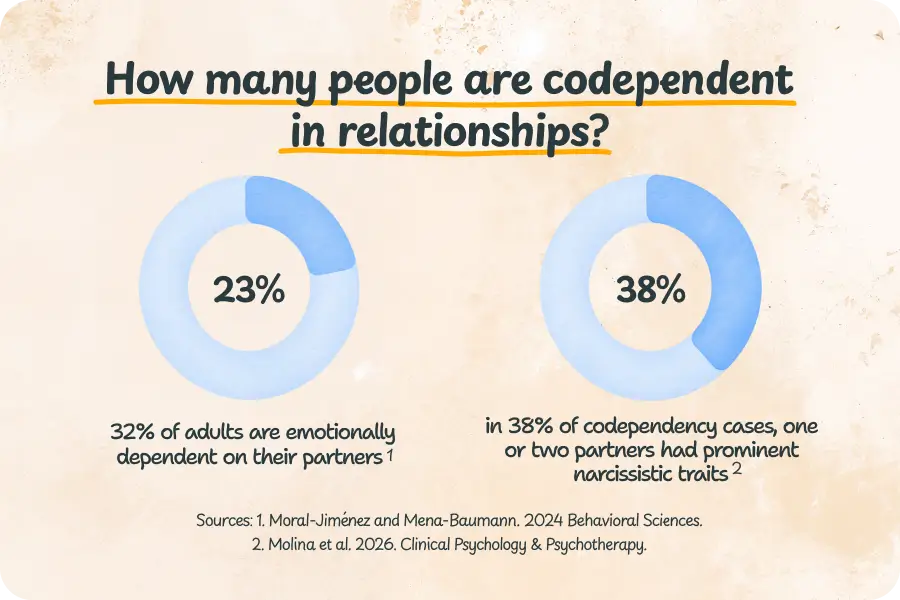
Studies confirm it as well: People who experienced emotional dependency on their partners admitted that the latter were noticeably more narcissistic [3] Emotional Dependence and Narcissism in Couple Relationships: Echo and Narcissus Syndrome. M. de la Villa Moral-Jiménez and A. Mena-Baumann. Behavioral Sciences (Basel). 2024. .
If you’re in a codependent relationship with a narcissist, your goal isn’t to change them. Like with any codependent relationship, you have to focus on yourself: your safety, your world, your autonomy.
Here’s how to stop codependency with someone like this:
- Stop explaining yourself. Long justifications give them more to argue with. Say what you will or won’t do and leave it there.
- Prioritize your own needs, even when they push back. People with narcissistic traits can make you feel guilty for having needs or prioritizing yourself. In such moments, remember that this is their reaction, not proof you’re wrong.
- Keep your responses short and neutral during conflicts, especially when they’re trying to provoke you.
- Stop trying to earn their approval. Your self-confidence has to come from somewhere other than their mood or intermittent kindness.
- Build emotional support through other relationships, like friends, family, or a mental health professional.
- Write things down. If they often deny what happened, notes help you trust your own memory.
- Recognize codependent behaviors in yourself. For example, notice when you rush to apologize for something you didn’t do.
“Expect pushback, especially at first. Common reactions include guilt-tripping, anger, criticism, the silent treatment, or a sudden burst of charm meant to pull the person back.
Behavior often gets worse before it settles (an “extinction burst”), so consistency matters more than perfect wording. The person may never accept the boundary, and the goal is to keep it whether or not they agree.
If boundaries are met with threats, intimidation, or attempts at control, that is a safety issue, and the National Domestic Violence Hotline (1-800-799-7233) can help.”
How to Deal With a Codependent Partner
When you notice that your partner becomes too clingy or needy, don’t rush to throw a “codependent” label on them. Most probably, their overgiving or over-dependence is their not-so-perfect way to deal with the uncertainty, not intentional manipulation.
If you genuinely love the person, but their signs of codependency make you uncomfortable, you can try this:
- Talk openly about relationships so both you and your partner can honestly share feelings and worries without blaming each other.
- Encourage their own interests and friendships. For example, you can set one evening a week for both of you to be devoted to hobbies or time alone.
- Let them make their own decisions instead of deciding for them.
- Keep your boundaries, like “I appreciate your help, but I’ll handle this one myself.”
- Suggest couples therapy if you keep getting stuck.
You can maintain relationships that are close and warm while still asking for space.
When It’s Time to Go: How to Get Out of a Codependent Relationship
Leaving is never easy, but sometimes it’s the healthiest choice you can make.
If you decide to leave, plan it like any big change. Tell a few people you trust, sort out practical things like money and housing, and decide in advance how much contact you’ll keep. Low or no contact is best for long-term healing.
The Bottom Line
Breaking codependency takes time.
What starts as a survival strategy is hard to change. You can’t just say to your brain, “No, don’t do this thing that you were doing to protect me my whole life.” Your brain can be convinced that this fear and control helped you survive. Why would it give up a working strategy?
The status of “the giver,” “the fixer,” “the rescuer” sticks. Sometimes, it’s so ingrained with your identity that it’s hard to know who you are when you aren’t the perfect spouse, parent, or child.
But you get to figure this out, which can be a good thing.
You’ve been everyone’s safe place for a long time. Now, it’s time to take care of yourself.
Sources:
- Healthy Lifestyle in Adolescence: Associations with Stress, Self-Esteem and the Roles of School Violence. A. González Moreno and M. del Mar Molero Jurado. Healthcare (Basel). 2023.
- Differentiation of Self and Dyadic Adjustment in Couple Relationships: A Dyadic Analysis Using the Actor-Partner Interdependence Model. J Lampis, S. Cataudella, M. Agus, A. Busonera, E. A. Skowron. Family Processes. 2021.
- Emotional Dependence and Narcissism in Couple Relationships: Echo and Narcissus Syndrome. M. de la Villa Moral-Jiménez and A. Mena-Baumann. Behavioral Sciences (Basel). 2024.
Disclaimer
This article is for general informative and self-discovery purposes only. It should not replace expert guidance from professionals.
Any action you take in response to the information in this article, whether directly or indirectly, is solely your responsibility and is done at your own risk. Breeze content team and its mental health experts disclaim any liability, loss, or risk, personal, professional, or otherwise, which may result from the use and/or application of any content.
Always consult your doctor or other certified health practitioner with any medical questions or concerns
Breeze articles exclusively cite trusted sources, such as academic research institutions and medical associations, including research and studies from PubMed, ResearchGate, or similar databases. Examine our subject-matter editors and editorial process to see how we verify facts and maintain the accuracy, reliability, and trustworthiness of our material.
Was this article helpful?