



Podcast name
I dont know what to do with my life! Podcast
This article gives you 10 actionable steps to figure out what you should do with your life. Below, you’ll also find the free “What should I do with my life?” quiz and 3 free exercises to do when you don’t know what to do.
How to figure out what to do with your life? 10 steps
Our plan for figuring out what to do with your life consists of 10 steps:
- Admit and accept uncertainty in your life.
- Find out who you really are (values, habits, behavior, personality type, etc.).
- Discover your passions and interests.
- Start doing anything, even if it turns out to be a mistake.
- Separate what you want from what society expects.
- Return to what you loved as a child.
- Put yourself in uncomfortable, unusual situations.
- Consume different sorts of media.
- Try therapy or coaching.
- Schedule things you decided to do to change in your life.
You can do these in other sequences or do only those things that feel most interesting and then slowly pave the way to more uncomfortable, harder, new things. The only must-do is to take action.

1. Admit and accept
The first thing to do to figure out what to do with your life is to admit that you don’t have all the answers. None of us do!
What’s more: You probably won’t ever find THE answer. One thing that unites us is that we’re uncertain most of the time throughout our entire lives. Is this my dream career? Am I on the right path? Nobody can give you the confirmation.
And it’s a good thing because when you question things, it means you evolve. Your tastes change. Your life’s purpose is different now. Thanks to the experience you have, you make better-informed decisions now.
2. Find out who you really are
What if you wonder, “What am I doing with my life?” because you have suppressed your inner self? You suppressed the core of you, the best parts of your personality. You did this because something in your early childhood taught you that being yourself isn’t safe. You had to put on these other identities to survive.

A study from Bologna University found that people with strong identities were more committed and had a better sense of autonomy and purpose. Besides that, knowing who you are improved participants’ emotional stability and even relationships with other people, which indirectly improved mental health [1] Identity Matters for Well-Being: The Longitudinal Associations Between Identity Processes and Well-Being in Adolescents with Different Cultural Backgrounds. F. De Lise, K. Luyckx, E. Crocetti. Journal of Youth and Adolescence. November 2023. .
3. Discover your passions and interests
Your real passion is something that you are willing to suffer for, according to Carl Jung. It’s something that sounds interesting, even if you’re tired.
It’s completely normal if your well-paying job isn’t your passion. Career development ≠ personal development. A job can be simply your means of survival.
“I don’t know what to do with my life. Am I the problem?” No, you just might not have experienced doing what you actually want yet. It’s never too late to start.
4. Pick anything and just start
The biggest trap when you’re not sure what to do with your life is saying, “I’ll wait until I know for sure.” The reality is that waiting doesn’t bring you more understanding—it only fuels overthinking and makes you feel overwhelmed.
The truth is, you probably won’t know if something is right until you actually try it. So pick anything. Choose an option and tell yourself, “Maybe I’d like this.“
You might actually be wrong, but at least you are moving instead of waiting. Action gives you real feedback. If you try it, fail, or realize it’s not for you, that is experience, essential data that helps you adjust your course and try again.
5. Separate yourself from the opinion of others
Much of the panic surrounding “not knowing what to do” comes from a hidden fear of disappointing everyone else. From an early age, we unconsciously absorb the expectations of family, parents, and society. In addition to expectations, the pressure of social media, friends, and the work environment adds up when we grow up.
Ask yourself honestly:
6. Return to what you loved as a child
You can’t figure out what to do with your life because you lost your spark, playfulness. Do you know when you had that spark? In your early childhood.
Your childhood self didn’t evaluate activities based on your career choice—you engaged in them purely for the intrinsic pleasure of the experience.
Try doing the things you enjoyed in childhood. Some of them may have never left you completely. These early interests will lead you in the right direction to activities that you can possibly do in adulthood as well.
Expert Insight
The social media narrative has completely idealized the concept of ‘living your best life’ and ‘finding your calling.’
Living our best loves does not mean becoming immune to hardship or messy periods. Living our best lives means embracing all seasons and striving to remain grounded on one’s pursuit of happiness.
Social media tends to only showcase the ‘good’ and leaves out the imperfections, which would make these ‘best lives’ feel more human.
Also, ‘finding your calling’ is rarely the fairy tale social media portrays. Typically, finding one’s calling can be arduous and chalk-full of trials and errors.
Callings don’t have to be lavish to be important. Practicality and not losing sight of the ‘point’ of a calling is a lot harder than social media likes to let on.

Katherine Scott
Mental health professional
7. Make yourself uncomfortable
It’s easy to lose meaning when you stay in your warm, comfortable bubble—you simply keep receiving the same old feedback from the same familiar environment.
So, do the things that are scary and uncomfortable deliberately. Yes, your brain will do everything possible to convince you that the way things are is just fine. You’ll feel that the security and comfort you have are not worth the trouble of moving forward.
You might choose to wait, but the feeling that you stay stuck or have unrealized potential won’t leave you. In a few months or years, you’ll regret not starting now. Taking the leap of faith is THE path forward.
8. Consume a LOT of media
Read books, watch movies, binge your favorite TV shows, read opinion articles, listen to music, go to the theaters, and play video games. Everything works: both fiction and non-fiction.
What’s the point in watching TV, you’ll ask? Characters in media often represent values we have or set an example we want to follow.
So, pay attention to the moments when a character or situation in media makes you say, “Hey, that is so me!”
9. Try therapy or coaching
Trying to untangle your entire life direction inside your own head often leads to overthinking. When you feel confused about your future or career decisions, it’s time to bring in an objective professional who can transform your progress.
A therapist or life/career coach doesn’t hand you a pre-made map for your future. What they do instead:
10. Actually schedule things
Reading advice and reflecting on ideas is inspiring, but nothing changes until you act. Once you have a few ideas of what you want to try next, write them down and book specific times for them in your calendar.
Once an action is intentionally booked in your calendar, it is much harder to postpone it or say, “Oh, I’m tired, I’ll just do it another day.“
What should I do with my life? Quiz with free results
This 8-question test will help you determine what you should do next in your life so that it feels more meaningful.
Choose an option that feels more true and realistic to you.
3 Exercises for figuring out what to do with your life
These exercises are for those who wonder, “What to do when you don’t know what to do?“
They are perfect to start with because they’re like a playground where you can fantasize about the most unhinged things without the fear of making a wrong choice.
1. Odyssey plan
Feeling stuck in circumstances stems from the false belief that you only have one true destiny.
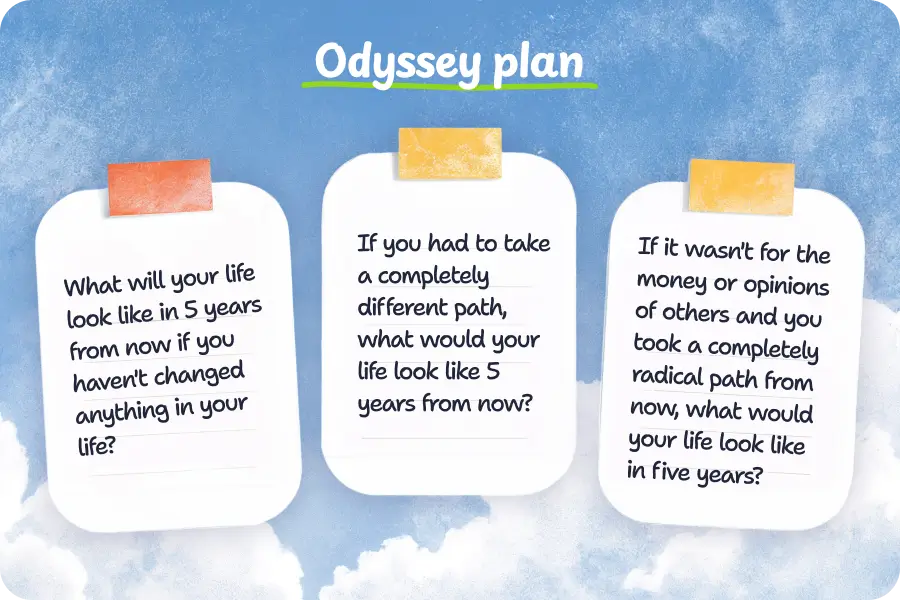
The Odyssey Plan forces you to map out three entirely different careers and paths. Here’s how to do it:
- Take a pen and pencil and divide your paper into three columns.
- Then, ask yourself three questions:
- What will your life look like in 5 years from now if you haven’t changed anything in your life?
- If you had to take a completely different path, what would your life look like 5 years from now?
- If it wasn’t for the money or opinions of others, and you took a completely radical path from now, what would your life look like in five years?
- Pay closer attention to the second and third paths. These are your honest, unfiltered answers that you suppress due to social conditioning and hyper-rationalizing.
By visualizing radical life courses, high-stakes decisions feel less permanent and less scary.
2. Ikigai
Ikigai is a Japanese concept that literally translates to “reason of being.” It means the thing that brings you fulfillment, joy, and meaning.
In order to find your Ikigai, take a piece of paper and follow the instructions:
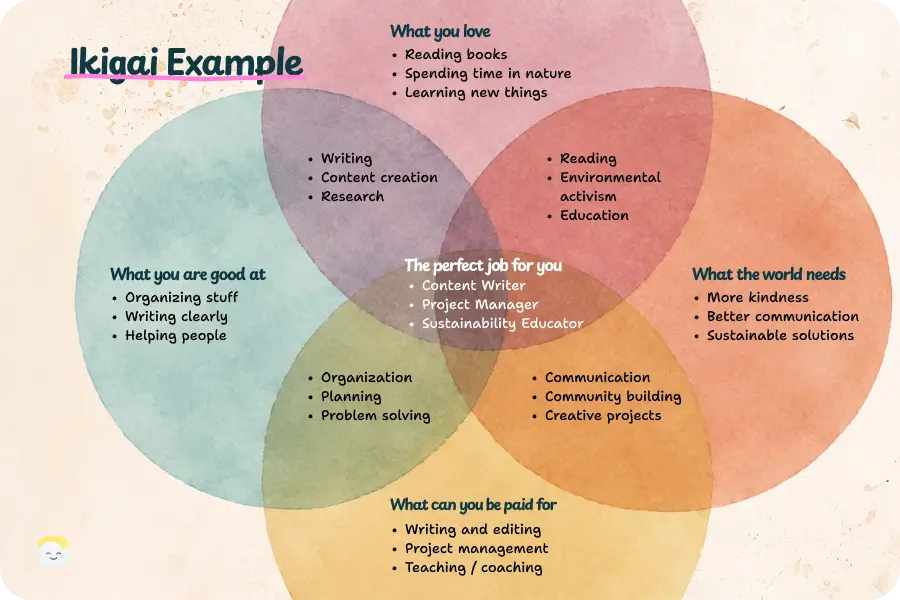
- Draw four circles as shown in the picture.
- In the first circle, write down 3 things you love to do.
- Use the second circle to write down 3 things you believe the world needs.
- In the third circle, write 3 things you can be paid for.
- The final circle is to be filled with 3 things you’re really good at.
What you have in the center at the crossovers of circles is your Ikigai, the thing you’re interested in and can be paid for. Use the example below or read the international bestseller Ikigai: The Japanese Secret to a Long and Happy Life if you need more guidance [3] Ikigai: The Japanese Secret to a Long and Happy Life. H. García, F. Miralles. Penguin life. August 2017. .
3. “Happy me” exercise
Your experience already has an answer for what you should do next in life. Here’s how to use it:
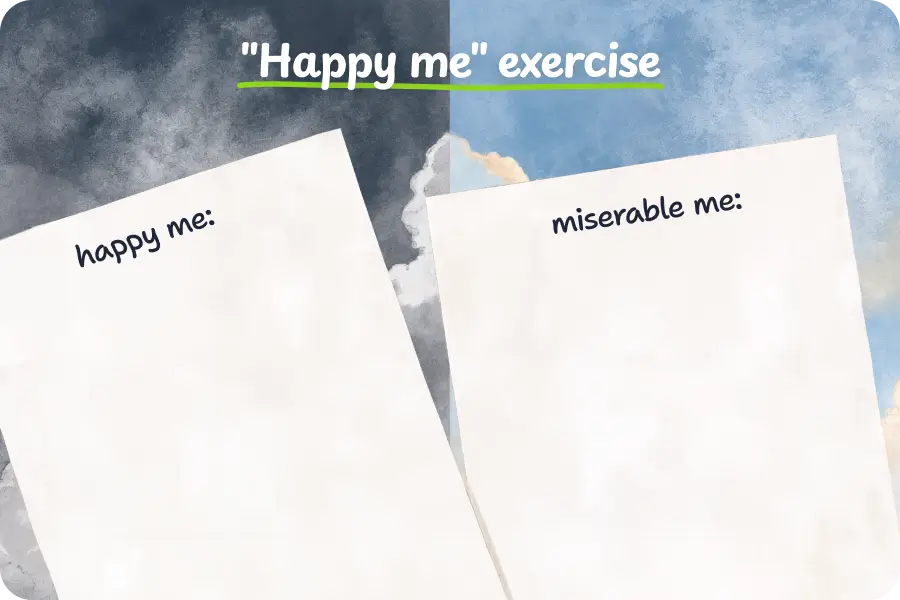
- Draw a vertical line down the center of a piece of paper.
- Title the left column “Happy me” and “Unhappy me.”
- Close your eyes and recall a time in your life when you felt genuinely happiest. It doesn’t matter if it was during childhood or a brief summer years ago.
- Write down what your average week looked like during that period, including the smallest details, when you woke up, what you did, who you were meeting, etc.
- On the right side, document times when you feel stuck. How do your days look now?
This exercise is so effective because happiness consists of small daily moments. There won’t be a point in life when you reach THE meaning. The meaning is a process built brick by brick.
Why can’t I figure out what to do with my life? 5 potential reasons
If you keep thinking, “I don’t know what to do with my life,” it doesn’t mean you are fundamentally broken. Uncertainty is a normal response to the following conditions:
“I don’t know what I want to do with my life” is a trap
The goal to “figure out” what to do in your life isn’t realistic.
Having one life purpose is risky because it ties your entire self-worth and happiness to a single outcome that can fail or change. When you expect only one purpose, you have no room for mistakes but to follow the pre-selected path.
Do you have the same goals and morals as you had 5 years ago? Now, imagine that you absolutely HAVE TO follow the goals and dreams you set in your 20s when you’re in your 50s. Doesn’t seem realistic, does it?
This is why a much more sustainable strategy is focusing on what you should do next, not what you should do in your life.
If it feels like there are too many options, that’s because there are. You will inevitably miss out on something. As philosopher Søren Kierkegaard observed, regret is a part of human freedom: taking action brings the pain of poor outcomes, but standing still brings the haunting ache of “what if.”
Yes, it might sound grim, as if whatever you do, you’ll definitely regret it. But if we think about it, inevitable regret is liberating. If there are no right choices, why bother?
True happiness comes from accepting the regrets and owning your life with its mistakes and curvatures.
Expert Insight
My favorite phrase for all seasons of life is to look for the beauty in all the unusual places. Sometimes, the beauty around us can be blinding, however most of the time beauty rests in the ordinary.
Journaling at the end of the day the ‘one good thing’ that was present and perhaps hiding behind the stressor or the mundane may have been overlooked. However, when we begin to train our eyes to find the beauty, we can begin to marinate in a feeling of deeper satisfaction.
Katherine Scott
Mental health professional
Frequently asked questions
Why is my life so miserable?
You may feel miserable for many reasons: unprocessed trauma, mental health conditions, chronic stress, lack of novelty and excitement, social comparison, etc. However, most people don’t like their lives because they’re disconnected from their values and don’t do things that excite them. Feeling down is your brain’s way to alert you that something needs to change.
Is it normal to not know what to do with your life at 30/40/50?
Yes, it is completely normal. When you mature, it’s totally normal for your values and even your whole life outlook to change. Most people spend their 20s and early 30s fulfilling traditional things like earning money, finishing school, exploring a career, creating a family, etc. Once you’re mostly done with it, it’s okay to feel confused about what to do next.
In addition, with age, you start to shed social expectations and learn that the opinions of others don’t define you. You start to learn what it means to actually live YOUR, not someone else’s, life.
How do I figure out what to do with my life when I have no interests?
First off, address anhedonia, the inability to feel pleasure or interest, which is a classic sign of burnout, mental exhaustion, or some mental health conditions. Focus on mental rest and physical recovery. Get enough sleep, more movement, and nutritious meals.
Second, be kind to yourself. Don’t force yourself to find a “passion.” Simply do fun things that you enjoy. Third, don’t try to intentionally figure out what to do with your life. Focus on what you would like to do tomorrow. Because those are small moments that constitute our days.
What should I do with my life if there are just too many options?
Your current life point doesn’t mean it’s your permanent state. Start treating your life as a little research you do to explore yourself. Experiments on low stakes. Pick one skill or hobby that you find interesting and test it for two weeks. Action brings understanding. You can always adjust your course as you gather real data about your life.
Sources
- Identity Matters for Well-Being: The Longitudinal Associations Between Identity Processes and Well-Being in Adolescents with Different Cultural Backgrounds. F. De Lise, K. Luyckx, E. Crocetti. Journal of Youth and Adolescence. November 2023.
- Experiential avoidance in depression, anxiety, obsessive-compulsive related, and posttraumatic stress disorders: A comprehensive systematic review and meta-analysis. M. Akbari, M. Seydavi, Z. S. Hosseini, J. Krafft, M. E. Levin. Journal of Contextual Behavioral Science. April 2022.
- Ikigai: The Japanese Secret to a Long and Happy Life. H. García, F. Miralles. Penguin life. August 2017.
- Meaning search as a mediator between post-traumatic stress symptoms and burnout in the long-term recovery phase after the 2023 Kahramanmaraş earthquakes. M. Çınaroğlu, E. Yılmazer. Frontiers in Public Health. May 2026.
Disclaimer
This article is for general informative and self-discovery purposes only. It should not replace expert guidance from professionals.
Any action you take in response to the information in this article, whether directly or indirectly, is solely your responsibility and is done at your own risk. Breeze content team and its mental health experts disclaim any liability, loss, or risk, personal, professional, or otherwise, which may result from the use and/or application of any content.
Always consult your doctor or other certified health practitioner with any medical questions or concerns
Breeze articles exclusively cite trusted sources, such as academic research institutions and medical associations, including research and studies from PubMed, ResearchGate, or similar databases. Examine our subject-matter editors and editorial process to see how we verify facts and maintain the accuracy, reliability, and trustworthiness of our material.
Was this article helpful?