



Podcast name
What are mommy issues in men?
Early-season Chandler Bing was a charming guy, but he also couldn’t commit. He found flaws in his lovely girlfriends and was unable to get emotionally close to them. In 2026, people would say that Chandler had mommy issues.
If you’ve wondered what mommy issues are in men, you’re in the right place. This article explores how unresolved mommy issues show up in men and what partners/men can do about them.
The best part? Mommy issues can be transformed in adult life with our 8 recommendations. Spoiler: Start with a childhood trauma test.
What Are Mommy Issues in Men?
“Mommy issues” is a term that describes childhood trauma caused by mother figures during the formative years of a child’s life. Both men and women can have mommy issues, but they might show up differently.
Mommy issues often overlap with attachment issues. Mother-child relationships in early childhood create a blueprint for the brain to follow. The attachment theory claims that if the mother-son bond is absent, abusive, or painful, the child will develop insecure attachment styles. And what does that mean in adulthood?
- Adults with an avoidant attachment style (25%) prefer to keep a “safe distance” and never depend on anyone [1] Widom, C. S., Czaja, S. J., Kozakowski, S. S., & Chauhan, P. Does adult attachment style mediate the relationship between childhood maltreatment and mental and physical health outcomes? Child Abuse & Neglect. February 2018. . Their emotions in childhood were probably dismissed, or they had an absent mother who couldn’t provide the emotional connection children need.
- Men with an anxious attachment style (11%) present as the opposites of avoidants [1] Widom, C. S., Czaja, S. J., Kozakowski, S. S., & Chauhan, P. Does adult attachment style mediate the relationship between childhood maltreatment and mental and physical health outcomes? Child Abuse & Neglect. February 2018. . They may seem clingy, afraid people will leave them, and obsess over their relationships. Anxious attachment issues develop when a child receives inconsistent affection and emotional support and, therefore, learns to hold onto every “affection opportunity.”
Mommy issues vs. daddy issues in men
Mommy and daddy issues are both key to how a boy grows up and sees himself. “Daddy issues” is a term to describe a trauma inflicted by dads or father figures. The biggest difference between a mother vs. a father wound is in the area they influence:
- Since in most families, the mother is a primary caregiver, she’s expected to provide essential emotional support to the son. If she fails, the boy may develop low self-esteem, poor boundaries, strained relationships with other women, etc. So, mommy issues in men concern mostly intimacy, self-perception, and the ability to build healthy relationships.
- A same-sex parent, though, can represent a behavioral model for kids. From fathers, boys learn authority, views of masculinity, relationships with power, and societal expectations. Men with daddy issues may have problems with authority and overcompensation.
Signs of Mommy Issues in a Man
Self-esteem issues
Signs of mommy issues in men generally start with their self-perception. Whether the mother figure was overly critical or praising, a man can develop various problems with self-worth that can look like this:
- He’s overly critical of himself, thinking, “Why am I so insecure?” and never feels satisfied with his achievements.
- He criticizes other people, especially women, to quickly boost his ego.
- He seeks constant reassurance in adult relationships that “he does a good job.”
- He may abuse substances, with 95% of men with low self-esteem being at risk of alcohol addiction [2] Lau, A., Li, R., Huang, C., Du, J., Heinzel, S., Zhao, M., & Liu, S. Self-Esteem Mediates the Effects of Loneliness on Problematic Alcohol Use. International Journal of Mental Health and Addiction. March 2023. .
Co-dependency on his mom
Mommy issues affect relationships with mothers later in life. This type of childhood trauma can make men either hate their mothers or love them over everything in the world. A man who’s overly dependent on his mother might:
- Compare every woman in his life to his mom.
- Consciously or unconsciously expect his romantic partner to be a “mom” in relationships: cook, clean, do laundry, provide emotional support, etc.
- Feel like his mom hates him.
- Easily get into codependent, strained relationships.
Low emotional intelligence
People learn to understand their emotions from their parents. When a man’s mother helped him identify and cope with his feelings in childhood, he grew up to have skills known as “emotional intelligence.”
However, emotionally distant parents don’t give their children the same opportunity. A guy with mommy issues who grew up without these opportunities can:
- Always resonate as feeling “bad” or “stressed” instead of nuanced emotions like “frustrated,” “tired,” “angry,” etc.
- Experience emotions as physical symptoms, such as a headache or tension.
- Need constant physical proof of love, like doing each other favors or doing a feat in the name of love.
- Be unable to regulate emotions, especially anger.
- Carry an emotional void, a derealization feeling like nobody cares about you or that nothing matters.
Mental health symptoms
Men with insecure adult attachment (anxious, avoidant, and disorganized attachment) styles were 42.6% more likely to develop depression and anxiety [3] Meng, X., D’Arcy, C., & Adams, G. C. Associations between adult attachment style and mental health care utilization: Findings from a large-scale national survey. Psychiatry Research. September 2015. . Among other mental health challenges caused by mommy issues are:
- Low self-worth and feelings that something is always wrong with you.
- General, social, or relationship-based anxiety.
- Higher likelihood of antisocial personality disorder (ASPD) or antisocial traits.
- Lower empathy, especially towards other women.
- Higher chance of developing narcissistic personality disorder or (covert) narcissistic traits.
Problems in adult relationships
In numerous studies, men with insecure attachment styles were less likely to be satisfied with their romantic lives. One Irish psychological questionnaire showed a simple but effective correlation: the better the relationship with your mother (as a son), the better the relationship with your female partner will be [4] Gleeson, G., & Fitzgerald, A. Exploring the Association between Adult Attachment Styles in Romantic Relationships, Perceptions of Parents from Childhood and Relationship Satisfaction. Health. July 2014. .
Otherwise, guys with mommy issues behave like this in relationships:
- He exhibits controlling behavior toward his partner.
- He overreacts when women show dissatisfaction.
- He’s clingy or seems overly dependent on his significant other.
- He doesn’t respect women and dismisses their feelings.
- He’s unaffectionate (avoids physical affection, sex, touches, etc.)
- He cannot tolerate being alone and gets into a new romantic relationship almost immediately after a breakup.

4 Examples of Mommy Issues Behavior in Men
- One woman on Reddit shared that her romantic partner with mommy issues expected her to carry all the emotional and physical load in the relationship. Not only was he opposed to the idea of doing household chores, but he also couldn’t deal with his emotions. The woman said she had to calm him down and cheer him up all the time, but he could never support her.
- A “bad girl chaser” is a type of man who tries to win the attention of unavailable women. This term first became popular on TikTok when users noticed that men chase goth girls just for the sake of a sense of achievement. Men who chase “bad girls” don’t value love in romantic relationships. They want a girlfriend who will make them look better in society.
- Men who ghost or leave their partners hanging and then return, expecting them to be there, also might have mommy issues. They expect their partners to love them unconditionally and always be there for them, just like their mothers did.
- “He couldn’t believe I still loved him when I was mad at him,” wrote one woman who had intimate relationships with a man with a mother wound. She shared that he couldn’t even imagine that two people can disagree and still love each other and even stay together.
The examples of men with mommy issues above are real and were collected anonymously from social media and forums.
How Signs of Mommy Issues Develop in Males
There are a few theories that explain where mommy issues come from. Processes that form consciousness are so complex and tightly intertwined that we cannot be sure where one process begins and the other ends. Hence, neither of them is fully accurate, with the truth being somewhere in the middle, as usual.
Here are a few mechanisms that potentially explain why some men have unresolved issues with their mothers:
- Oedipus complex
It’s impossible to talk about mommy issues without mentioning Freud. Freud’s theory claims that children aged 3-6 view the opposite-sex parent as an object of their unconscious sexual desires. That said, this theory is known to be criticized in the scientific community and is rather viewed as a metaphor for independence.
- Social Biofeedback Theory
This theory says that children learn about emotions and emotional regulation from their primary caregiver. A “perfect” parent in Social Biofeedback Theory is the one who “reflects back” children’s emotions in a marked way (e.g., exaggerated sad face + soothing voice when the baby is distressed). When the primary caregiver (usually the mother) doesn’t do this consistently, a child may lack emotional permanence skills.
- Self-Efficacy Theory
This theory claims that if overprotective mothers don’t let their children learn from their experience, they lack the primary source of self-efficacy: mastery experiences (the ones a person gains by successfully performing a task). Absence of mastery experiences can lead to a lack of self-awareness and complicated relationships. A recent survey on overprotective parenting confirms this, with nearly 40% of children with overprotective mothers having depression [5] Huang, S. The relationship between parental overprotection and student depression: The chain mediation role of psychological control and well-being. PLoS One. July 2025. .
Nicole Arzt, LMFT, shares what was the most common reason for men’s mommy issues in her experience,“Inconsistent attachment can be a significant threat to the attachment system. When you don’t know what “mood” you’re going to receive or how your mother might respond to a given situation, you may be more prone to hypervigilance or hyper-independence. This can carry on through the lifespan.”
How to Tell if a Guy Has Mommy Issues
Dating a guy with mommy issues can bring many challenges. The behavior of men with mommy issues is possible to explain. But it doesn’t mean that this harmful behavior is justified or can be dismissed.
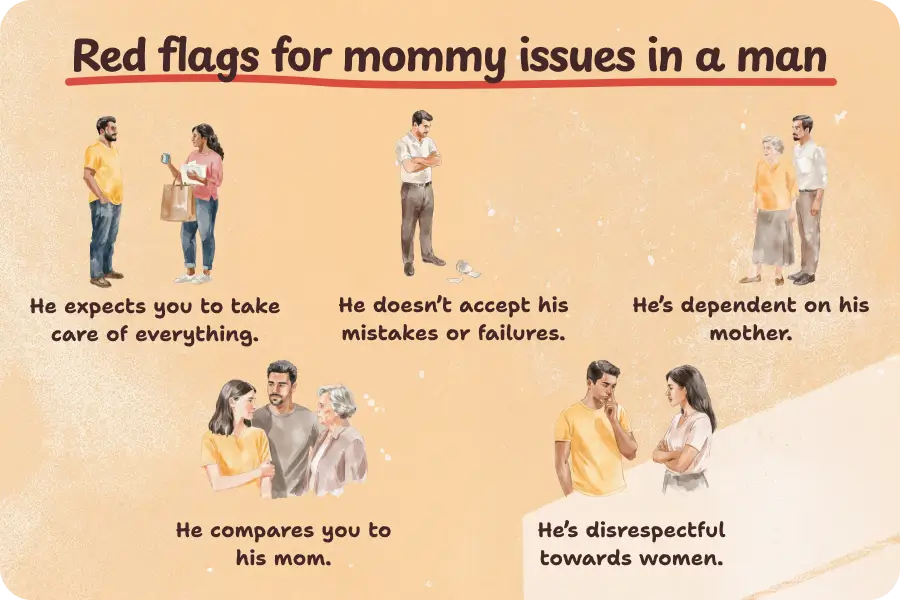
If you don’t want to get stuck in such an unhealthy dynamic, information about what mommy issues look like is your best protection. Keep an eye out for the following red flags of mommy issues in a guy:
- He’s extremely enmeshed with his mom: lets her make his major decisions, cancels plans for her, lets her cross set boundaries, etc.
- He talks badly about his mom.
- He defends his mom, even if she’s objectively not right.
- He disrespects women in general.
- He makes generalizations about women, such as calling certain women “Karens” or “bitches.”
- He cheats or gets emotionally involved with other women, expecting you to bear with it.
- He’s extremely jealous.
- He’s scared of you leaving or cheating.
- He imitates a child when he makes mistakes, like puckering his lips, talking in a higher tone, expecting you to comfort him, etc.
- He doesn’t accept criticism, dismissing your comments with sarcasm or frustrated outbursts.
- He expects you to do all the household chores.
- He doesn’t take care of you physically or emotionally.
- He refuses to reflect on how early childhood can still influence him, saying, “It’s just who I am.”
- You feel unsafe physically or emotionally around him.
- He refuses to change anything.
How to Deal With Men With Mommy Issues
If you want to build healthy relationships with your man, who might have mommy issues, you can use our therapist-backed advice:
Set boundaries
If your man does something that triggers you, like compares you to his mom, checks your phone, or talks badly about women, be open with him that you feel uncomfortable. A man who wants to have a fulfilling relationship with you will care about your reactions and needs.
Do not know how to set healthy boundaries without feeling “pushy”? Our PDF attached below navigates you through this uneasy process.

Have an honest conversation
Adult relationships are built on honesty and conversations, not mind-reading. If you don’t share your genuine feelings and worries about your romantic partner, you won’t know what to do about it. Start a conversation with your feelings, using “I” statements, like “I feel betrayed when you constantly check my phone.”
There is a point where both perspectives are true. He has mommy issues, which may be the context, but you feel hurt, which is also a valid context. And when you come to this point, you can create a personal growth plan for your romantic relationships.
Seek therapy
If your romantic partner with mommy issues is open to seeking professional help, couples therapy is a highly effective solution. We can recommend Emotion-Focused Therapy (EFT) because its treatment effectiveness for partners with insecure attachment styles exceeds 70%! [6] Sprenkle D. S. Effectiveness Research in Marriage And Family Therapy. October 2004.
5 Tips for Men to Deal With Mommy Issues
A man who thinks he might have mommy issues already did a lot of work: he realized that mommy issues affect his personal relationships and mental health. It’s also important to understand the following: working on yourself, especially on childhood trauma, isn’t a bed of roses. You must challenge the belief system you followed your entire life.
Don’t worry, your brain is flexible and can evolve. Here are a few evidence-based strategies for fixing mommy issues:
1. Take better care of yourself
Adult children who experienced childhood trauma are usually disconnected from their feelings and needs. Self-care doesn’t mean spoiling yourself or procrastinating on social media. It means becoming a responsible parent for yourself.
For example, if you feel tired or can’t do anything because of the brain fog, the act of self-care would be to take the rest of the day off to take a walk, cook a healthy meal, or clock in these 8 hours of sleep. Mental health is a direct reflection of physical well-being.
2. Engage in introspection
Introspection in psychology means self-observation: exploring your reactions and thoughts and connecting them to your life experience. There are numerous methodologies with introspection at heart. For example, meditations, journaling, mood tracking, etc. All of these are available for free in the Breeze app.
Introspection and an analog lifestyle help to develop skills of self-reliance. This method also gives insights into your adult behaviors and improves emotional intelligence.
3. Practice vulnerability in personal relationships
Connections to other people are where mommy issues hit the most. It’s totally normal for you to have mixed feelings about people or talking openly with them. However, talking sincerely will benefit both parties in a man’s relationship.
What can you do? Small steps to invite healthy communication:
- Share with your partner/friends that you currently work on yourself, and you’d like their support (it’s not necessary to mention your mommy issues if you don’t want to).
- Seek closeness that is non-sexual with your close people. For example, share vulnerable facts about yourself, or practice physical affection like holding hands, embracing, or kissing on the forehead.
- Set healthy boundaries with people who make you feel bad, including your mom. You can limit certain topics, heightened tones, or unneeded advice.
- Don’t trauma-dump information on your significant other. Listen to them and ask personal questions to make them feel you care and that you’re equal partners.
4. Confront the victim’s mindset
If you engaged in therapy or other introspection methods, you may have discovered something you don’t like about yourself. Anything you found was a way for you to cope in childhood. But now you don’t have to be like that if you don’t want to.
To confront the victim’s mindset, you have to admit that you’re the one behind the wheel, driving the car of your own life. The next time somebody complains about you and deep down you realize it’s valid, apologize and take accountability. You can also ask your close circle what you can do to become a better husband, friend, or father to unlearn helplessness.
5. Seek therapy
Therapy remains the most effective way to address mommy issues’ struggles. Not everyone requires professional help, but if you consider therapy, seek specialized trauma-focused therapy.
Approaches that are especially common for mommy issues are:
- Psychodynamic therapy that explores childhood experiences.
- Attachment-based therapy helps develop an earned secure attachment.
- Inner child work helps you focus on improving self-esteem and learn that you deserve love.
- Family or couples therapy can explore how the experiences of both partners impact common relationships.
Is it necessary to confront your mother to deal with mommy issues? Nicole Arzt answers,“Not inherently. In some cases, it can be valuable to strive to repair familial dynamics, particularly if you sense your mother may be receptive. But it’s also important to have realistic expectations. Your mom may not change or hold herself accountable, and that can reinforce frustration or sadness.”
Frequently asked questions
Do all men who love their mothers have mommy issues?
No, men can love their mothers without mommy issues. Love for parents becomes unhealthy when the mother-son relationship becomes enmeshed, and the mother has too much control over the adult son’s life. Like when she makes important life decisions instead of him, comes over every day, doesn’t let him build a relationship with other women, etc.
How to know if you have mommy issues?
To know whether your relationship with your mother made a profound impact on you, compare yourself with these signs of mommy issues in a man: low self-worth, problems with romantic relationships, poor mental health, feeling hate towards women, etc.
Why do I attract men with mommy issues?
Men with mommy issues may be attracted to naturally nurturing and stable women, whom they view as other mother figures. Perhaps you embody a mother because you like to keep everything under control and take care of it. However, it’s also possible that the pool of men you currently date has a higher proportion of men with mommy issues.
Are mommy issues always consequences of an anxious attachment style?
Mommy issues are not always consequences of an anxious attachment style, but they can be tightly intertwined. People who have any insecure attachment styles (anxious, avoidant, or disorganized attachment) are more likely to develop mommy issues. But they are also more likely to develop daddy issues, PTSD, substance use disorder, low self-esteem, etc. It all depends on the social context in which a child grew up.
Sources (Accessed March 2026)
- Widom, C. S., Czaja, S. J., Kozakowski, S. S., & Chauhan, P. Does adult attachment style mediate the relationship between childhood maltreatment and mental and physical health outcomes? Child Abuse & Neglect. February 2018.
- Lau, A., Li, R., Huang, C., Du, J., Heinzel, S., Zhao, M., & Liu, S. Self-Esteem Mediates the Effects of Loneliness on Problematic Alcohol Use. International Journal of Mental Health and Addiction. March 2023.
- Meng, X., D’Arcy, C., & Adams, G. C. Associations between adult attachment style and mental health care utilization: Findings from a large-scale national survey. Psychiatry Research. September 2015.
- Gleeson, G., & Fitzgerald, A. Exploring the Association between Adult Attachment Styles in Romantic Relationships, Perceptions of Parents from Childhood and Relationship Satisfaction. Health. July 2014.
- Huang, S. The relationship between parental overprotection and student depression: The chain mediation role of psychological control and well-being. PLoS One. July 2025.
- Sprenkle D. S. Effectiveness Research in Marriage And Family Therapy. October 2004.
Disclaimer
This article is for general informative and self-discovery purposes only. It should not replace expert guidance from professionals.
Any action you take in response to the information in this article, whether directly or indirectly, is solely your responsibility and is done at your own risk. Breeze content team and its mental health experts disclaim any liability, loss, or risk, personal, professional, or otherwise, which may result from the use and/or application of any content.
Always consult your doctor or other certified health practitioner with any medical questions or concerns
Breeze articles exclusively cite trusted sources, such as academic research institutions and medical associations, including research and studies from PubMed, ResearchGate, or similar databases. Examine our subject-matter editors and editorial process to see how we verify facts and maintain the accuracy, reliability, and trustworthiness of our material.
Was this article helpful?