



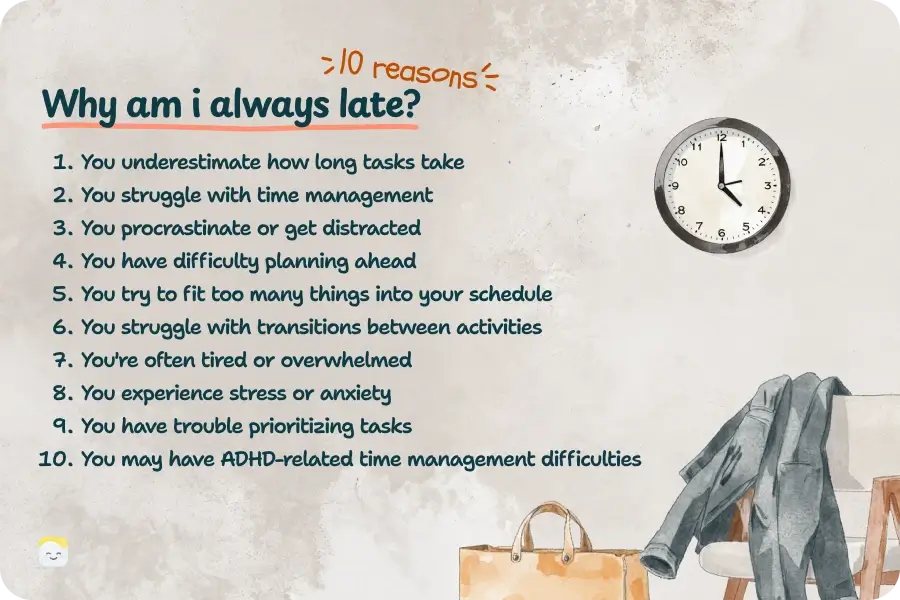
You may be late all the time because you underestimate preparation time, lose track of the clock, struggle to stop what you’re doing, or feel anxious about where you’re going. An overloaded morning or an unreliable commute can also affect your arrival time. Chronic lateness can have several causes, so the most useful first step is finding where your own routine slips.
If you’re late to work or appointments despite trying, use the reasons below to identify the delay and test a realistic departure routine.

7 reasons for chronic lateness
Maybe you wake up early, promise yourself today will be different, and still leave with wet hair and an apology ready. You can take responsibility for it while getting curious about what needs to change.
1. Planning fallacy makes a best-case plan feel realistic
The planning fallacy describes underestimating how long something will take, even when similar experiences have run over before. Your plan might assume an empty road and a bag that’s already packed.
A study by the Behavioral Insights Team suggests that the planning fallacy is closely linked to optimism bias—the tendency to expect favorable outcomes [1] Behavioural Insights Team. A review of optimism bias, planning fallacy, sunk cost bias and groupthink in project delivery and organisational decision making. August 2017 . To plan your next trip more realistically, use your past experiences as a guide rather than assuming everything will go smoothly.
2. You have an overloaded schedule
A routine can become unrealistic when you’re exhausted or responsible for more than it allows. Walking the dog, answering an urgent email, choosing an outfit, preparing your breakfast, and handling last-minute chores can easily eat into your time. These tasks still count even when you’re used to fitting them around everything else.
Check whether you’re asking too much of that window. Reducing one optional commitment may be more useful than trying to move faster through every step.
3. One more task interrupts the transition
An extra email can turn into a conversation. A quick tidy can reveal laundry that needs folding. If you regularly lose track while absorbed in an activity, the difficult moment may be stopping.
For some people, ADHD hyperfixation may help explain intense absorption. However, you don’t need that label to notice that your phone or an unfinished job keeps pulling you back.

4. You experience anxiety or perfectionism
Anxiety may show up as another outfit change, repeated checking, or putting off an uncomfortable situation. If you have neurotic tendencies, such as excessive worrying or heightened sensitivity to stress, these behaviors may become more frequent. You might be ready physically while still struggling with the idea of walking into a crowded room.
Perfectionism, in turn, may delay departure when you’re afraid your appearance or preparation isn’t good enough.
Expert Insight
Further exploring this pattern comes with learning more about the dread or fear of arriving early. Questions to ask could include; What does your brain say is the worst part about arriving early? What does it think will happen if we have to face the feeling?

Hannah Schlueter
Mental health professional
5. Time blindness can make passing minutes hard to notice
Time blindness is an informal term for difficulty noticing time passing or judging durations. Your sense of how much time has passed may differ from the clock [2] Ptacek R, Weissenberger S, Braaten E, Klicperova-Baker M, Goetz M, Raboch J, Vnukova M, Stefano GB. Clinical Implications of the Perception of Time in Attention Deficit Hyperactivity Disorder (ADHD): A Review. May 2019 . You sit down for five minutes, look up, and discover that your departure window has disappeared.
6. Poor planning leaves out the small steps
Poor time management sometimes starts with an incomplete picture of the journey. A 20-minute drive doesn’t include finding keys, reaching the car, parking, or walking to the right office.
A 2016 experiment with 70 adults found that underestimating a task’s duration could carry into plans and leave too little time before a later target [3] Emily R. Waldum and Mark A. McDaniel. Why are you late? Investigating the role of time management in time-based prospective memory. August 2016 . Remembering the deadline wasn’t enough. The planning fallacy can hide inside these missing details.
7. Outside constraints affect your arrival
Unpredictable transit, disability-related needs, caregiving, and changing work demands can affect punctuality. Other factors may remain outside your control even when you’re planning ahead.
How to stop being chronically late
Think about your last late arrival. Did you start getting ready too late, get distracted halfway through, or leave on time and encounter a delay? Each answer suggests a different change.
1. Name the concern before changing the timetable
Are you uncertain about who will be there, or worried about making a mistake? Notice whether chronic lateness happens everywhere or mainly before particular events. Being constantly late for a stressful meeting with your boss deserves a different response from forgetting how long breakfast takes.
Try journaling about situations that trigger your lateness. Guided journaling in the Breeze app will help you explore your emotions and recurring worries to better understand what’s holding you back.

2. Measure how long tasks really take
This is one practical response to the planning fallacy. Measured durations can help you judge how long each task takes more realistically, without treating every late morning as a failure of effort.
- Time your usual routine for a few typical days.
- Include the tasks you usually forget to budget for. You need an ordinary morning to see where the time goes.
- Compare your time estimate with the actual time. If you budget ten minutes for breakfast and cleanup but usually need 18, update the plan.
3. Build your schedule backward
Start with when you need to be inside and ready. Subtract each stage to find a leave-by time, then work backward through preparation.
For a 9:00 appointment, an example might look like this:
| Time | What needs to happen |
| 7:40 | Begin your 30-minute essentials routine |
| 8:10 | Collect your bag |
| 8:15 | Leave home and allow five minutes to reach the car |
| 8:20 | Start the 20-minute journey |
| 8:40 | Park and take the five-minute walk to reception |
| 8:45-8:55 | Keep ten minutes in reserve for delays |
| 8:55 | Check in before the 9:00 appointment |
4. Set a no-new-tasks cutoff
- Choose a point before departure when optional tasks stop. At 8:05, you might stop answering messages, changing outfits, or tidying. Only the agreed essentials remain.
- If procrastination plays a part, notice whether small chores help you avoid starting the thing you dread. Write the chore down for later instead of beginning it.
- The cutoff also counters optimism bias. Having ten minutes left doesn’t automatically mean there’s room for a ten-minute job. Your buffer is already doing something useful.
5. Give every alarm a next action
Link each alarm to a concrete departure ritual. Replace a vague reminder with action labels such as “Close laptop” or “Shoes on, leave now.”
You can set multiple alarms if each marks a useful transition. Too many can become background noise, so keep only the cues you respond to. Visual timers can make the remaining window easier to see.
6. Make leaving easier the night before
- Prepare the essentials the night before to reduce morning stress:
- Put your keys, bag, and anything essential in one place.
- Choose clothes when you have more breathing room.
- Prepare for the morning you usually have. If you’re often tired or distracted, don’t build a routine that requires perfect focus. Poor time management can improve when the environment supports the next action.
- Pick one preparation step first. When you’re building daily routines, make room for tired evenings too. An elaborate system can become another thing to maintain.
7. Leave early with a plan for waiting
- Choose an arrival target before the official start. For a 9:00 appointment, you might aim for 8:45 and bring a book for the wait. Adjust the margin for your needs and the venue’s check-in requirements.
- You don’t have to fill every spare minute. When you leave early and arrive with room to settle, you can be fully present instead of starting with an apology.
- If time blindness makes spare time hard to judge, choose an activity you can stop easily. The waiting plan should support the appointment, not create another difficult transition.
A 7-day plan to arrive on time
Use a week to learn about your pattern. The goal is to find a workable time management adjustment, not to prove you can follow a perfect schedule.
Days 1-2: Record where the minutes go
Note when you intended to leave, when you left, and what happened in between. Add a word about your mood. You may see distraction, anxiety, or an overloaded routine repeating.
Try Breeze’s mood tracker to log how you feel throughout the day, identify emotional patterns linked to lateness, and better understand how your mood affects your daily routine.

Days 3-5: Test one change
- Choose the biggest restriction. Try an essentials-only morning, a departure cue, or a more realistic travel allowance. Keep the rest of your routine manageable.
- If the planning fallacy keeps appearing, compare your estimates with the durations in your records. Avoid reclaiming the extra margin for another job.
Days 6-7: Review and adjust
Count departures that improved, even if you were still a few minutes late. Ask:
- what helped
- what made the plan difficult to follow.
Time awareness and emotional regulation both matter. If worry repeatedly blocks leaving, another reminder is less useful if you’re not addressing that worry. Let the pattern guide your next step.
What to say when you’re running late
Tell the person waiting as soon as you have a realistic update. Acknowledge the effect, give an honest ETA (Estimated Time of Arrival), and let them decide whether the revised plan works.
For example, you may say, “I’m sorry to keep you waiting. I haven’t left yet, and I expect to arrive at 6:20. Would you prefer to start without me?”
Avoid getting defensive or saying “on my way” before leaving. Follow relevant workplace procedures for arriving late or missing deadlines. Once you’re there, discuss one concrete adjustment for next time.
When professional support may help
Consider professional guidance when chronic lateness repeatedly affects work, relationships, or essential appointments despite practical changes. Seek help sooner if anxiety, persistent sleep difficulties, or other mental health concerns are making daily activities hard.
Broader, longstanding ADHD symptoms may be worth discussing with a qualified clinician. Executive functioning includes skills involved in organizing and starting actions; difficulties with those skills need a fuller assessment than punctuality alone.
If repeated criticism has affected your self-esteem, a therapist can help you address the shame alongside the practical difficulties. You may bring your timing notes to explain where your routine breaks down.
Frequently asked questions
1. Why can't I be on time for anything?
Common possibilities include optimistic estimates, forgotten preparation steps, distractions, difficult transitions, and anxiety. Unpredictable responsibilities can contribute too.
Good intentions don’t automatically translate into an accurate plan. You might remember the appointment but forget how long the steps before it usually take. Or you might know when to leave and struggle to act on that cue.
2. Is chronic lateness a mental illness?
Chronic lateness describes a behavior. Being late all the time by itself doesn’t establish ADHD or another underlying condition. Timing difficulties can occur alongside wider attention or mental health concerns. If several persistent difficulties affect your functioning, a clinician can assess the broader picture.
3. What does it say about a person who is chronically late?
It shows a punctuality problem that needs attention, not a complete account of your character. People can care and still struggle to manage time. What matters next is acknowledging the impact and following through on a realistic change.
4. Why am I always late even when I wake up earlier?
Extra time can disappear into scrolling, chores, or more decisions. If your leave-by time stays vague, waking earlier may simply lengthen the routine. Keep a fixed list of essentials and protect the departure window from optional tasks.
5. Why do I ignore reminders when I'm running late?
You may dismiss a familiar sound automatically or postpone it while finishing something. Multiple alarms can lose their impact. Pair one cue with an immediate action, make the clock visible, and reduce whatever competes with leaving.
Sources
- Behavioural Insights Team. A review of optimism bias, planning fallacy, sunk cost bias and groupthink in project delivery and organisational decision making. August 2017
- Ptacek R, Weissenberger S, Braaten E, Klicperova-Baker M, Goetz M, Raboch J, Vnukova M, Stefano GB. Clinical Implications of the Perception of Time in Attention Deficit Hyperactivity Disorder (ADHD): A Review. May 2019
- Emily R. Waldum and Mark A. McDaniel. Why are you late? Investigating the role of time management in time-based prospective memory. August 2016
Disclaimer
This article is for general informative and self-discovery purposes only. It should not replace expert guidance from professionals.
Any action you take in response to the information in this article, whether directly or indirectly, is solely your responsibility and is done at your own risk. Breeze content team and its mental health experts disclaim any liability, loss, or risk, personal, professional, or otherwise, which may result from the use and/or application of any content.
Always consult your doctor or other certified health practitioner with any medical questions or concerns
Breeze articles exclusively cite trusted sources, such as academic research institutions and medical associations, including research and studies from PubMed, ResearchGate, or similar databases. Examine our subject-matter editors and editorial process to see how we verify facts and maintain the accuracy, reliability, and trustworthiness of our material.
Was this article helpful?