


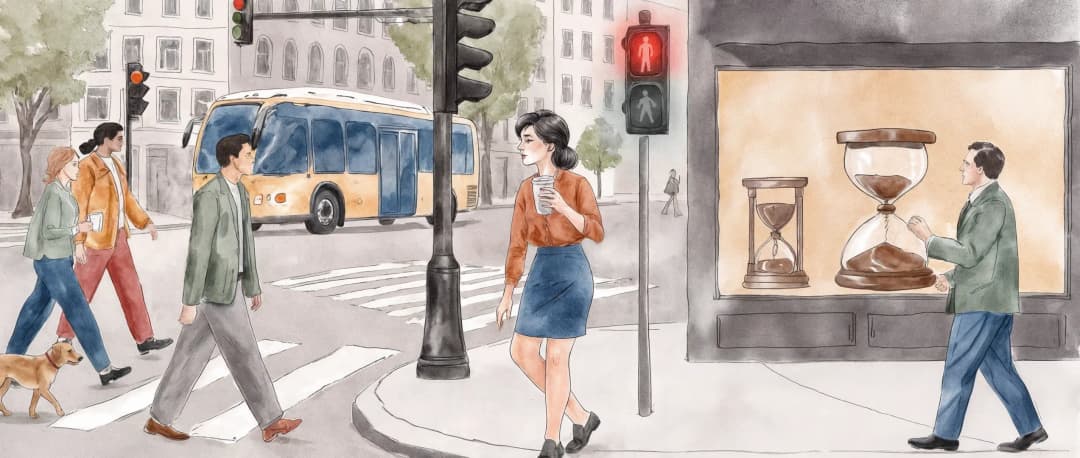
You want things to happen now and can’t stand waiting for people to respond, for plans to come together, or for results to appear. Even small delays in your daily life can cause irritation and feel unbearable. This article makes sense of why you’re impatient and offers practices to improve self-regulation.
8 Reasons You Might Be an Impatient Person
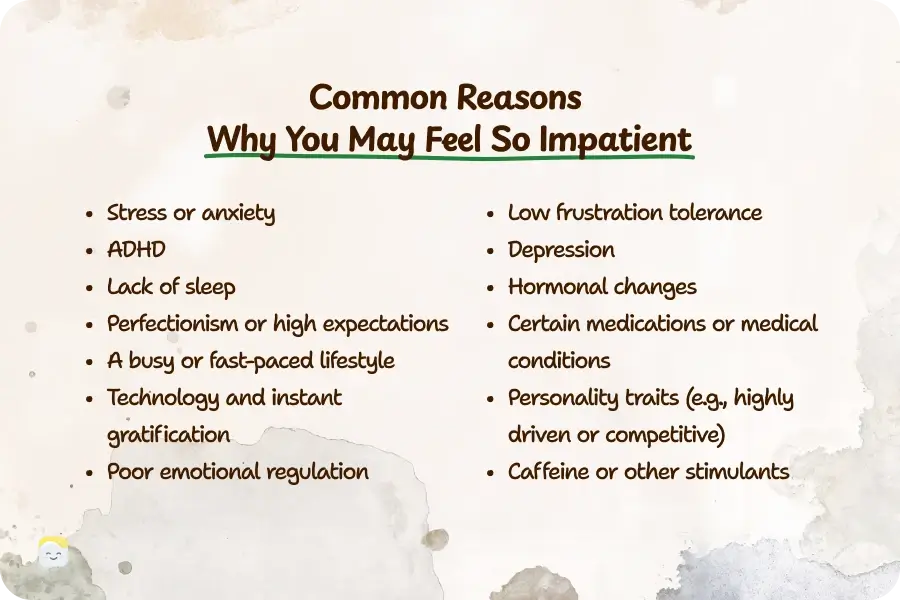
Impatience can feel like a personality trait you were simply born with. However, there can be underlying causes for this emotional reaction, including stress, anxiety, sleep problems, certain medical conditions, or other psychological factors [1] South Richardson, D. Everyday Aggression Takes Many Forms. 2014 . A deeper understanding of what may be driving your impatience can help you become aware of your triggers and find healthier ways to deal with them.
1. You Want Control
One of the biggest reasons for impatience is the need to feel in control. Waiting feels like you cannot change the situation immediately, and that uncertainty can be uncomfortable.
When you do not know when something will happen, your mind may keep asking, “Why isn’t this happening yet?” You want an answer so that you can feel safe and prepared. The frustration may therefore come less from the waiting itself and more from feeling powerless.
Wondering if your behaviors might be unintentionally toxic? Take the “Am I Toxic?” quiz to gain insights into your patterns and start improving your relationships.

2. You Have High Expectations
You may expect yourself to learn quickly, other people to respond immediately, or your plans to work exactly as expected. When reality does not match those expectations, every obstacle feels like wasted time.
High expectations can also make you overly critical of yourself. You may feel that you should already know more, perform better, or have everything figured out. When you can’t meet the standards you’ve set for yourself, you may experience self-doubt.
3. You Are Stressed or Tired
Impatience can become worse when you are mentally or physically exhausted. When you have little energy left, it’s difficult to tolerate uncertainty. A small delay that normally would not bother you can suddenly feel unbearable.
Ready to understand your anger better? Take the Anger Test to explore your emotions and identify patterns that cause frustration.

4. You Compare Your Progress With Other People
Social media can worsen impatience because you constantly see other people’s achievements. It can feel quite relentless. Someone appears to have the career, relationship, body, lifestyle, or success you want. You may then think, “Why am I not there yet?”
5. You Overthink While Waiting
Waiting becomes especially difficult when your mind fills the silence with possibilities. For example, if someone has not replied, you might wonder whether they are ignoring you. Or, if something has not worked yet, you might assume you are failing. The longer you wait, the more thoughts you create. In this situation, impatience may actually be anxiety disguised as frustration.
6. You Are Hard on Yourself
Impatience can be directed inward, not just toward other people. You may become frustrated when you make mistakes, learn slowly, lose motivation, or fail to reach your goals as quickly as you expected. You might think you should already be better. This kind of impatience can turn into self-criticism: “Why can’t I just get it together?”
Do you often feel like you’re not good enough? Take the Impostor Syndrome Test to explore whether self-doubt, perfectionism, or unrealistic expectations may be affecting your self-perception.
7. You Have Learned to Avoid Boredom
Your brain becomes accustomed to instant gratification. If you are constantly checking your phone, watching something, listening to music, or switching between tasks, moments of doing nothing can cause discomfort. Waiting in a queue or sitting quietly gives your brain nothing to consume, so impatience arises.
8. You Might Have A Medical Condition
If the impatience is new, extreme, worsening, or accompanied by major changes in sleep, mood, concentration, impulsivity, or behavior, it would be reasonable to discuss it with a doctor or mental health professional.
Think you might have ADHD? Taking the ADHD quiz for women can help you identify common ADHD symptoms and determine whether it may be worthwhile to seek a professional assessment from a therapist.
5 Strategies to Gain More Patience
So if you are asking, “Why am I so impatient?”, the answer may not be that something is wrong with you. You may be stressed, ambitious, afraid of uncertainty, accustomed to immediate results, or simply expecting too much from yourself and the world. This is a very common part of the human experience.
Like many emotional skills, the ability to stay patient can be strengthened with practice. Here’s how you can practice patience:
1. Develop the Habit to Pause Before You React
The purpose is to interrupt your automatic reaction. Are you irritated by a slow driver, a delayed message, a long queue, or someone taking too long to explain?
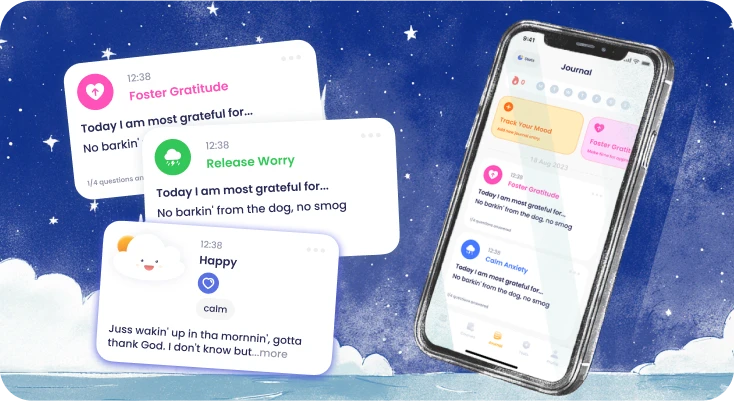
If you want to change your daily habits, the Breeze app offers powerful routines to help you feel calmer and manage daily stress. Another benefit of using Breeze is a better understanding of your emotions and higher emotional intelligence. The app provides journaling prompts to explore your thoughts, emotions, and everyday experiences in a structured way and build greater emotional awareness.
2. Practice Tolerating Small Delays
Patience develops through exposure to situations where you have to wait. Once a day, introduce a small amount of waiting into your routine.
The important part is to observe what happens. You may notice thoughts such as “This is taking forever” or “I don’t have time for this.” Instead of arguing with those thoughts, acknowledge them and return your attention to what you are doing. You’re teaching yourself that waiting is uncomfortable, but it is manageable.
Expert Insight
It is valuable to cultivate mindfulness, and that often entails building tolerance for sitting with boredom. It is in this space that we can connect to our thoughts, feelings, and bodily sensations. Boredom also often enhances one’s capacity to tap into creativity.

Nicole Arzt
Mental health professional
3. Challenge the Thoughts Behind Your Impatience
Impatience often begins with a thought about how quickly something should happen. You might think, “They should have replied by now,” or “This shouldn’t be taking so long.” These thoughts can intensify frustration even when the situation itself isn’t particularly serious.
The following exercise can help you replace unrealistic expectations with a more accurate assessment of the situation. When you notice impatience, write down:
| What I expected | “This should take 10 minutes.” |
| What is actually happening | “It is taking 20 minutes.” |
| What I can control | “I can decide how I use these extra 10 minutes.” |
| What I cannot control | “I cannot speed things up or make the other person move faster.” |
4. Practice The 60-Second Reset
When you’re tired, stressed, hungry, overstimulated, or emotionally overwhelmed, your tolerance for frustration can become much lower [2] Swami V, Hochstöger S, Kargl E, Stieger S. Hangry in the field: An experience sampling study on the impact of hunger on anger, irritability, and affect. July 2022 . Deep breathing and mindfulness can help you manage physical tension.
Try the 60-second reset to regulate your body:
Step 1. Notice the feeling. Tell yourself, “I’m getting impatient.”
Step 2. Stop what you’re about to do. Don’t send the message, interrupt, complain, or react immediately. Force yourself to pause.
Step 3. Take three slow breaths. Take a slow breath in and make your exhale slightly longer than your inhale. Count to three slowly.
Step 4. Relax your muscles. Release your jaw, lower your shoulders, and release your hands and forehead.
Step 5. Notice your surroundings. Identify a few things you can see and hear. This brings your full attention out of the frustrating thought and back into the present moment.
Step 6. Reassess. Ask, “What does this situation actually require from me?”
Expert Insight
Try to just take in the scene. Activate your five senses by engaging in sight, sound, smell, touch, and taste. Allow yourself to savor what simply “is” without trying to force external entertainment on yourself.
Nicole Arzt
Mental health professional
5. Stop Negative Self-Talk
If you’re constantly telling yourself that you’re behind, failing, or not improving quickly enough, you create the same frustration internally that you experience when other people move too slowly.
6. Schedule Regular Me-Time
Spending some intentional time alone can help you become more comfortable with slowing down and not constantly seeking stimulation or immediate results [3] Lisa Prescott Dixon, Brigham Young University. The Impact of Spending Time Alone on Emerging Adults’ Mental Well-Being. 2020. . Set aside 10–20 minutes without your phone, social media, or other distractions. Sit somewhere comfortable, take a walk, drink a cup of tea, or simply observe your surroundings.
With regular practice, these quiet moments can help you become more comfortable with boredom and waiting. Learning to enjoy your own company can also make it easier to tolerate situations that you cannot control or speed up.
Frequently asked questions
1. Why am I so impatient?
Impatience can have several possible causes, such as stress, anxiety, lack of sleep, high expectations, fear of uncertainty, and a strong desire for control. In some cases, persistent impatience may also be associated with conditions such as ADHD, anxiety disorders, or mood disorders.
2. Is impatience a personality trait?
It can be part of your personality, but it is not necessarily something you are simply born with. Your environment, habits, stress levels, experiences, and mental or physical health can all influence how patient you are.
3. Can anxiety make me impatient?
Yes. Anxiety can make waiting and uncertainty particularly uncomfortable. If you are constantly anticipating what might happen next, you may feel frustrated when you cannot get an immediate answer or outcome.
4. Can ADHD cause impatience?
Impatience can be a common feature of ADHD, particularly when it occurs alongside impulsivity, difficulty waiting, restlessness, or a strong need for stimulation. However, impatience is part of being human, and that feature alone does not mean that someone has ADHD.
5. How can I stop being so impatient?
Start by identifying what triggers your impatience. When you notice it, pause before reacting and ask yourself whether the situation is urgent or whether you simply want it resolved immediately. Improving sleep, managing stress, increasing self-awareness, and learning to tolerate delayed rewards can also help.
Sources
- South Richardson, D. Everyday Aggression Takes Many Forms. 2014
- Swami V, Hochstöger S, Kargl E, Stieger S. Hangry in the field: An experience sampling study on the impact of hunger on anger, irritability, and affect. July 2022
- Lisa Prescott Dixon, Brigham Young University. The Impact of Spending Time Alone on Emerging Adults’ Mental Well-Being. 2020.
Disclaimer
This article is for general informative and self-discovery purposes only. It should not replace expert guidance from professionals.
Any action you take in response to the information in this article, whether directly or indirectly, is solely your responsibility and is done at your own risk. Breeze content team and its mental health experts disclaim any liability, loss, or risk, personal, professional, or otherwise, which may result from the use and/or application of any content.
Always consult your doctor or other certified health practitioner with any medical questions or concerns
Breeze articles exclusively cite trusted sources, such as academic research institutions and medical associations, including research and studies from PubMed, ResearchGate, or similar databases. Examine our subject-matter editors and editorial process to see how we verify facts and maintain the accuracy, reliability, and trustworthiness of our material.
Was this article helpful?