


Talking to your parents about childhood trauma can be one of the most emotionally difficult conversations you ever have. You may want acknowledgment, an apology, an explanation, or simply the chance to finally say that you were struggling. Here’s how to protect your mental health during extremely difficult communication.
Wondering whether you experienced trauma as a child? Take a test to explore how it may affect your self-worth and the way you cope with negative feelings.

Prepare Yourself Emotionally
Before starting a conversation about childhood trauma, consider what you hope to get from it and whether your emotional safety can withstand an unexpected response.
At the same time, confronting a parent does not automatically lead to healing. They may listen and take responsibility, or they may become defensive, deny what happened, minimize your experience, or turn the conversation back on you. The purpose does not have to be getting your parents to admit that you are right.
You can prepare your words, choose the right setting, establish boundaries, and decide when to leave. You cannot make another person understand your experience or take responsibility for it.
If you already know that the conversation could put you at risk of emotional, physical, or financial harm, your safety comes first. You do not need to confront your parents for your experience to be valid.
If you are under 18, still live with your parents, depend on them financially, or are currently being harmed, confronting them may increase your risk. Consider talking first with a trusted adult, such as a school counselor, relative, or therapist. For support, you can contact the Childhelp National Child Abuse Hotline at 1-800-422-4453, or call or text 988 if you are in crisis.

What to Say: A Step-by-Step Framework
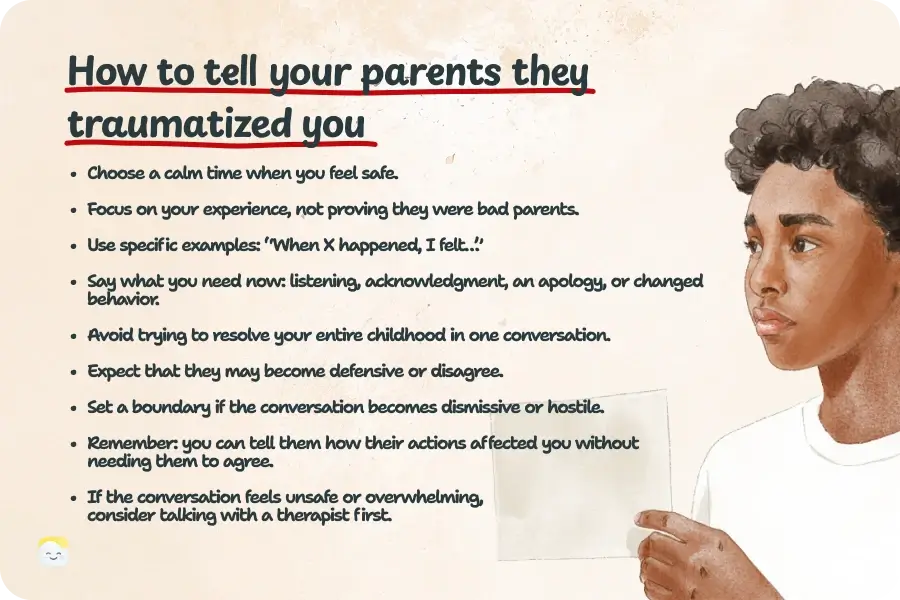
You do not need to explain your entire childhood in one conversation. In fact, trying to cover everything at once can make an already difficult conversation overwhelming.
1. Choose the purpose of the conversation
The first step is deciding what you want your parent to know. Ask yourself:
- What do I want to say?
- What do I hope my parent will understand?
- Am I looking for an apology, acknowledgment, an explanation, or simply an opportunity to speak?
- How would I feel if they denied what happened?
- How would I cope if they became angry?
- What would I do if they refused to continue the conversation?
- Do I have someone supportive to turn to afterward?
For example: “I want to talk about something from my childhood that has affected me for a long time. I’m not bringing this up to attack you. I need you to understand how those experiences affected me.” This establishes that you are talking about your experience rather than trying to win an argument.
2. Describe specific experiences
When possible, focus on concrete situations to make it easier to communicate what you mean.
❌ “You were always a terrible parent.”
✅ “When I was upset as a child, I often felt that my feelings were dismissed. I learned to keep things to myself because I didn’t feel safe talking about them.”
3. Use “I” statements
An “I” statement does not mean taking responsibility for someone else’s behavior. It simply describes your experience without requiring the other person to immediately agree with your interpretation.
These “I” statements can help keep the conversation centered on your experience:
- “I felt afraid when…”
- “I remember feeling…”
- “That experience affected me by…”
- “I still struggle with…”
- “What I needed at that time was…”
- “I want you to understand that this was painful for me.”
4. Say what you need now
If you want something specific from your parent, tell them:
- “I don’t need you to explain it away. I need you to listen.”
- “I’m not asking you to have the same memory I have. I’m asking you to understand that this experience affected me.”
- “If we’re going to have a relationship, I need you to respect this boundary.”
Is your family toxic? Take a test to reflect on your experiences, identify patterns that may be affecting your emotional well-being, and better understand your relationships.
How to Handle Their Reaction: 3 Scenarios
Even when you carefully prepare for the conversation, your parents’ reaction may surprise you. They may respond with empathy and take responsibility. Or, they may become defensive, insist that you remember things incorrectly, or say they were doing the best they could.
1. What if your parents deny your childhood trauma?
Denial can be particularly painful because it can lead to self-doubt and to questioning your own memories and feelings.
You do not necessarily need to prove your memories to them because your healing does not depend on obtaining a confession.
2. What if they become defensive?
When you want to discuss their unhealthy behaviors, your parents may respond by immediately defending their intentions.
Try to return to your experience rather than getting pulled into an argument about whether they were a “good” or “bad” parent.
Wondering whether you may experience glass child syndrome? Take the test to identify potentially unhelpful coping strategies that may still be influencing your life.
3. What if they turn themselves into the victim?
A conversation about your pain can sometimes become a conversation about how hurt they feel being confronted.
Their pain may be real, but you do not have to abandon the original subject to take care of their emotions. If the conversation becomes manipulative or hostile, you may end it.
What to Do If They Refuse to Listen
Sometimes the healthiest outcome of a difficult conversation is recognizing that the other person is not willing or able to have it with you.
1. Set a boundary
A boundary is not a demand that another person behave differently. It is a decision about what you will do. For example:
- “If you start yelling at me, I will end the conversation.”
- “I’m willing to talk about this if we can both remain respectful.”
- “I’m not going to continue this conversation if my experiences are mocked or dismissed.”
And then follow through. If the conversation becomes emotionally unsafe, you can leave, hang up, or take a break. You do not have to keep explaining yourself until your parent finally agrees.
2. You are allowed to step back
After confronting a parent, you may realize that you need more distance.
That could mean:
- having shorter conversations;
- avoiding certain topics;
- communicating primarily by text;
- taking a temporary break from contact;
- reducing contact;
- or, in some situations, ending contact.
How to Heal Without Parents’ Approval: Self-Care Tips
One of the hardest realizations in recovering from childhood trauma is that your parents may never give you the response you hoped for. They may never apologize or fully understand, and continue to see their behavior differently. That does not mean you have to remain trapped in the past.
1. Don’t rely on their apology to validate your experience
An apology can be meaningful, but it is not the only path toward healing. You can acknowledge what happened, recognize how it affected you, and decide what you need now, even if the person who hurt you refuses to acknowledge it.
Healing may involve therapy, supportive relationships, learning about trauma responses, developing boundaries, or simply giving yourself the compassion you did not receive when you needed it.
Try journaling prompts in the Breeze app for deeper self-reflection and better understanding of your experience.

2. Give yourself the closure they cannot provide
Closure does not necessarily mean deciding that everything is forgiven or that the past no longer matters. You can grieve the childhood you wish you had without waiting for your parents to validate that grief.
Sometimes closure looks more like, “What happened to me mattered. I did not deserve it. I cannot change what happened, but I can decide how I want to live now.”
Moreover, talking to your parents does not have to end with a closer relationship. A successful conversation can create the possibility of rebuilding trust or clarify that stronger boundaries are necessary.
You are allowed to tell your story and protect yourself while telling it. And you can heal even if those who hurt you never give you the apology you hoped for.
3. Seek professional support
Childhood trauma can sometimes be associated with symptoms of post-traumatic stress disorder (PTSD), depression, anxiety, or problems with emotional regulation, research shows [2] Iram Rizvi SF, Najam N. Parental Psychological Abuse toward children and Mental Health Problems in adolescence. 2014 March . For some people, distress may also contribute to unhealthy coping strategies, including substance abuse or eating disorders [3] Young JC, Widom CS. Long-term effects of child abuse and neglect on emotion processing in adulthood. 2014 .
If you notice changes in your mental health, a therapist can help you:
- understand your trauma responses and symptoms;
- explore how childhood experiences may affect your mental health today;
- prepare for a difficult conversation with your parents;
- set boundaries without feeling responsible for everyone else’s feelings;
- work through shame, guilt, or blame.
- develop practical strategies for managing anxiety, depression, or anger.
You can also look for practical support outside therapy. A friend, partner, support group, or family member may provide reassurance before or after a difficult conversation. Connecting with people who have had a shared experience can make you feel comfortable and reduce the feeling that you are going through this alone.
Frequently asked questions
1. Should I tell my parents about my childhood trauma?
Not necessarily. You can choose whether, when, and how to talk to your parents about painful childhood experiences. Consider what you hope to gain from the conversation and whether you feel emotionally and physically safe enough to have it.
2. How do I know if I am ready to confront my parents?
You may be more prepared when you can identify what you want from the conversation and have a plan for different possible reactions. It can also help to have emotional support available afterward. You may want to wait if you feel pressured to confront them, expect them to change immediately, or believe their reaction could seriously destabilize you or put you at risk.
3. When is it time to talk?
It may be time to talk when you feel emotionally prepared to share your experience and can accept that your parent may not respond as you hope.
4. What if confronting my parents makes everything worse?
You are allowed to stop. Your well-being matters more than completing the conversation. If you anticipate retaliation, threats, violence, financial consequences, or another serious safety concern, consider getting support and making a safety plan before confronting them.
5. Can I heal from childhood trauma without talking to my parents?
Yes. Healing does not require your parents’ participation or approval. Therapy, supportive relationships, boundaries, self-compassion, and learning to recognize how past experiences affect your present can all be part of recovery.
6. Do I have to forgive my parents to move on?
No. Forgiveness is not a requirement for healing. You can work toward peace, acceptance, and a different future without deciding that what happened was acceptable or that your parents deserve forgiveness.
Sources
- National Library of Medicine. Child neglect and emotional abuse. October 2024
- Iram Rizvi SF, Najam N. Parental Psychological Abuse toward children and Mental Health Problems in adolescence. 2014 March
- Young JC, Widom CS. Long-term effects of child abuse and neglect on emotion processing in adulthood. 2014
Disclaimer
This article is for general informative and self-discovery purposes only. It should not replace expert guidance from professionals.
Any action you take in response to the information in this article, whether directly or indirectly, is solely your responsibility and is done at your own risk. Breeze content team and its mental health experts disclaim any liability, loss, or risk, personal, professional, or otherwise, which may result from the use and/or application of any content.
Always consult your doctor or other certified health practitioner with any medical questions or concerns
Breeze articles exclusively cite trusted sources, such as academic research institutions and medical associations, including research and studies from PubMed, ResearchGate, or similar databases. Examine our subject-matter editors and editorial process to see how we verify facts and maintain the accuracy, reliability, and trustworthiness of our material.
Was this article helpful?