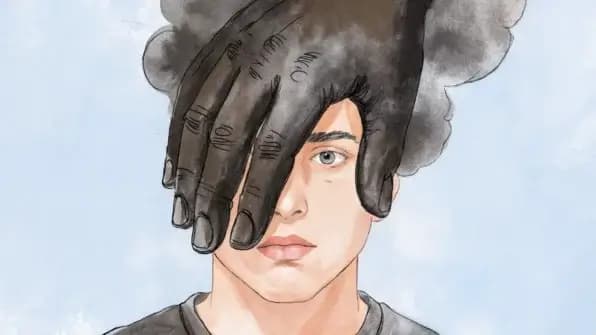



Does criticism, rejection, or being corrected seem to trigger an unusually disproportionate response in you, such as anger, defensiveness, withdrawal, or an intense need to prove you’re right? This kind of reaction is sometimes described as a narcissistic injury—a painful blow to a person’s sense of self, status, worth, or identity.
Wondering if narcissistic injury responses could be affecting your relationship? Take a test to recognize possible narcissistic traits in your partner’s behavior and spot narcissistic abuse.

What Narcissistic Injury Can Look Like: 4 Signs
Remember that one disproportionate reaction by itself doesn’t establish narcissism or psychological abuse. Anger or defensiveness can result from stress, trauma, frustration, fear, relationship conflict, or many other factors. The repeated pattern and the inability to acknowledge one’s own actions are what allude to a possible pattern of narcissistic injury.
1. Passive Aggressive Behavior
A narcissistic injury can also be followed by passive aggression or vindictiveness rather than open confrontation.
Imagine someone who strongly identifies as the most knowledgeable person in their workplace. During a meeting, a colleague points out a mistake in their calculations. A typical response might be, “You’re right. I missed that. I’ll correct it.”
A person experiencing a narcissistic injury might instead experience the correction as humiliation or an attack on their competence. They might respond with a sarcastic remark such as “Wow, someone woke up as the know-it-all this morning.”
Notice any toxic traits in your own behavior? Take this test to find out which ones you may have.

2. Narcissistic Rage
One common sign of an injury reaction is narcissistic rage. It’s an intense, angry, or hostile reaction to a perceived threat to a narcissistic self [2] Krizan Z, Johar O. Narcissistic rage revisited. May 2015 .
3. Silent Treatment
In response to a wounded ego, a person might refuse to talk, become emotionally distant, withhold affection, or give someone the silent treatment. For example, after receiving criticism, a partner might suddenly stop responding to messages and avoid discussing what happened.
It’s important to distinguish between taking space to calm down and using silence as a form of punishment or control. A person saying, “I’m too upset to talk right now; let’s continue tomorrow,” is communicating a boundary.
4. Seeking Revenge
When someone feels deeply hurt, criticized, rejected, or humiliated, they may feel a strong urge or impulse to “get even” or restore their sense of power. This can show up as verbal retaliation, spiteful comments, or attempts to make the other person feel hurt in return.
Seeking revenge does not necessarily mean the person is malicious or has narcissistic personality disorder. In some cases, it may be a defense mechanism triggered by perceived rejection, hurt, shame, vulnerability, or powerlessness. What matters is the pattern, intensity, and whether the person can eventually recognize the impact of their harmful behavior and take responsibility for it.
What Is a Narcissistic Injury?
Narcissistic wound or narcissistic injury refers to the emotional response that can occur when a person’s desired or idealized self-image is challenged, criticized, or threatened. The important point is that the injury is about a perceived threat to the self, not necessarily an objectively serious insult.
When another person’s words or actions contradict that inflated and fragile self-image, the experience may trigger shame, humiliation, insecurity, or a sense of being diminished. In people with significant narcissistic traits, these negative feelings can sometimes be followed by anger, denial, hostility, withdrawal, or attempts to restore their sense of superiority.
Narcissistic Injury vs Narcissistic Personality Disorder
Narcissistic injury is not a diagnosis. It is a psychological concept used to describe a particular type of threat response to self-esteem or self-image.
Narcissistic personality disorder is a mental health condition defined by a persistent pattern involving grandiose self-image, a need for admiration, and impaired empathy across different areas of life. The American Psychiatric Association emphasizes that having some narcissistic traits is not the same as having NPD; the traits must be persistent, inflexible, maladaptive, and associated with significant problems or impairment [1] APS. What Is Narcissistic Personality Disorder? January 2024 . Someone with NPD struggles to engage in self-reflection that could encourage growth and empathetic responses to others.
Common Triggers of Narcissistic Wound
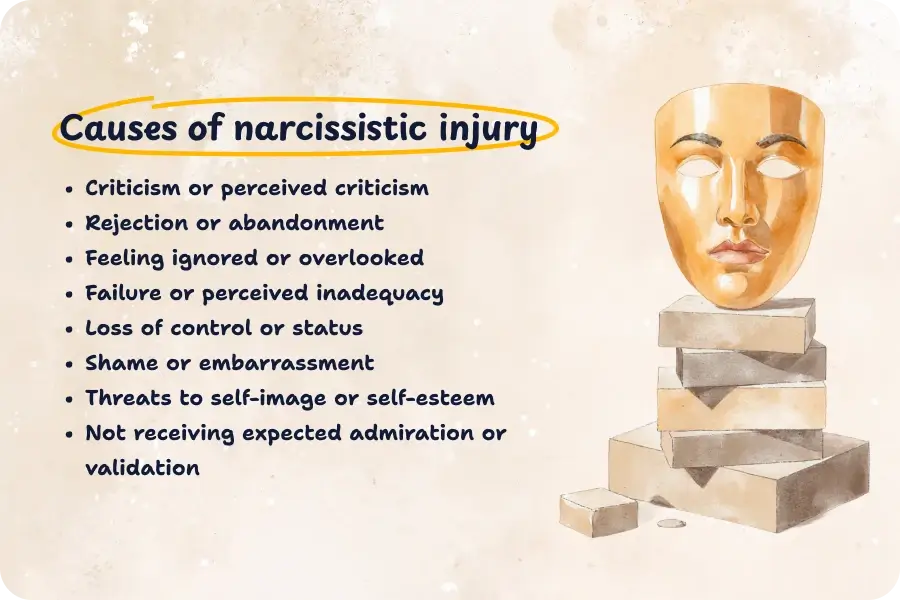
The following situations can trigger narcissistic injury:
- Criticism, especially if it challenges competence or character
- Rejection or abandonment
- Feeling ignored and not receiving expected attention or validation
- Failure
- Being contradicted, especially in front of other people
- Loss of status and no longer receiving admiration, authority, or recognition
- Comparison
- Exposure of mistakes, particularly when the person’s self-image depends on appearing flawless
- Relationship conflict when a partner sets boundaries or refuses to provide expected validation
How Narcissistic Injury Can Affect a Relationship
Ordinary disagreements can become difficult when one partner experiences disagreement as a threat to their self-worth.
A conversation that begins with “I felt hurt when you didn’t call me” can become, “So you think I’m a terrible partner?” The original concern gets replaced by a debate about the person’s character. The other partner may eventually become increasingly careful about what they say and stop raising concerns because they anticipate anger, withdrawal, blame, or retaliation.
This can create a cycle:
Concern → perceived criticism → shame or threat → defensiveness → anger or withdrawal → unresolved issue → repeated conflict [3] Nevicka B, De Hoogh AHB, Den Hartog DN, Belschak FD. Narcissistic Leaders and Their Victims: Followers Low on Self-Esteem and Low on Core Self-Evaluations Suffer Most. March 2018 .
How to Protect Your Mental Health & Respond to a Narcissistic Injury
When a partner reacts with intense defensiveness, anger, withdrawal, or passive-aggressive behavior, it can be tempting to explain yourself repeatedly or try to calm them down. But you cannot control another person’s reaction. What you can control is how you respond and how you protect your own well-being.
1. Focus on the Behavior, Not Diagnosis
If you are dealing with someone who repeatedly shows narcissistic behavior, try to focus on the behavior and how it affected you. Avoid trying to convince your partner that they are “narcissistic” during an argument.
You might say:
- “When I brought up the problem, you started criticizing me instead of discussing what happened. I want us to be able to talk about problems without attacking each other.”
- “We can disagree about what happened, but I don’t want this conversation to become insulting.”
- “I’m not attacking you. I’m telling you what happened for me and how it affected me.”
- “I’m willing to continue this conversation when we can both speak respectfully.”
You don’t have to convince someone that they are narcissistic in order to set a firm boundary. If conversations regularly involve intimidation, threats, humiliation, coercion, or fear, the priority is safety rather than winning the argument.
2. Don’t Take Responsibility for Their Emotions
You can acknowledge that your partner feels hurt without accepting blame for their reaction. You might say, “I understand that what I said hurt you. That wasn’t my intention, but I still need to be able to talk about things that concern me.”
Remember that someone feeling criticized does not automatically mean you did something wrong. Healthy relationships leave room for both people to express concerns, make mistakes, and hear feedback.
3. Stay Connected to Your Own Reality
Repeated conflict can make you question whether your feelings and expectations are reasonable. Keep track of patterns instead of judging yourself based on one difficult interaction.
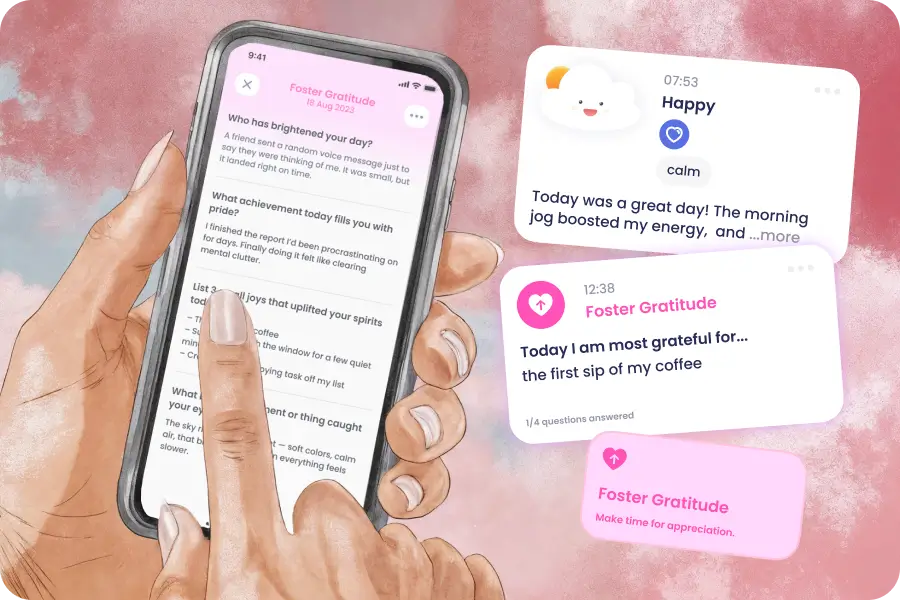
Journaling can help you record what happened, how you felt, and how the conflict was resolved. You can use guided journaling in the Breeze App to recognize recurring patterns that are difficult to see when you are in the middle of an emotional situation.
4. Consider Individual or Couples Therapy
Couples therapy may be an option when both partners are willing to participate and can communicate safely. A therapist can help you identify recurring patterns, improve communication, and work toward healthier ways of handling conflict.
Talking with a therapist can also provide an outside perspective and help you clarify your boundaries and needs. If a relationship involves intimidation, threats, humiliation, or coercive control, or makes you feel afraid, focus on your safety rather than trying to manage your partner’s emotional reactions. Professional support can help you think through your options safely.
Expert Insight
A narcissistic injury reaction is driven by a dysregulated central nervous system. When we react, we are driven by our emotional responses. This leaves very little room for us to pause and respond utilizing our logical minds. In order to better have access to our logical minds, we must attend to our bodies’ reactions. For example, when this reaction is triggered, our heart rates elevate, our breathing gets shallow, and we feel rage build within our bodies. Own this reaction, learn and utilize coping tools to regulate these somatic experiences, and then make decisions on how you would like to proceed, navigating the circumstance that triggered the narcissistic injury.

Katherine Scott
Mental health professional
What to Do If You’re the One Experiencing Narcissistic Injury
Recognizing that you feel deeply hurt, criticized, rejected, or threatened can be uncomfortable, but it can also be an opportunity to understand your reactions and respond differently. Experiencing narcissistic injury does not mean you have narcissistic personality disorder. What matters is how you handle the feelings that arise.
1. Pause Before Reacting
If a conversation suddenly becomes heated, give yourself time to step back. This can help you avoid reacting with anger, blame, or withdrawal. You do not have to resolve the conflict immediately.
Try taking a few slow breaths, going for a short walk, or waiting until you feel calmer before continuing the conversation. A simple statement like, “I want to talk about this, but I need some time to calm down first,” can help create space and prevent escalating the conflict.
2. Identify What Feels Threatened
Ask yourself: “What exactly about this situation feels so painful?” It may be criticism, rejection, feeling incompetent, losing control, or feeling unimportant. Naming the underlying emotion can make it easier to respond rather than react.
3. Separate Criticism From Your Self-Worth
Making a mistake or receiving negative feedback does not mean you are incompetent, unworthy, or a failure. Try to consider whether there is useful information in the feedback without treating it as a judgment of your entire identity.
4. Take Responsibility for Your Reaction
You may not be able to control what someone says or how it makes you feel, but you can choose how you respond. If you become defensive, insulting, or passive-aggressive, or withdraw to punish someone, acknowledge it and consider how you could handle the situation differently.
Try this simple exercise. After a difficult interaction, write down what happened and compare your automatic reaction with a more constructive response:
| What happened? | My automatic reaction | What was I feeling underneath? | A healthier response |
| My partner pointed out a mistake. | I became defensive and argued. | Shame, embarrassment, and fear of looking incompetent. | “I feel embarrassed, but I can acknowledge the mistake.” |
| My partner disagreed with me. | I became sarcastic and dismissive. | Feeling rejected or not respected. | “I don’t like being disagreed with, but we can have different opinions.” |
| My partner criticized something I did. | I brought up their mistakes. | Hurt, anger, or feeling unfairly judged. | “I feel criticized right now. Can we focus on this issue without attacking each other?” |
| My partner wanted to discuss a problem. | I stopped responding to punish them. | Feeling overwhelmed or afraid of conflict. | “I need some time to calm down. Let’s talk about this later.” |
The goal isn’t to judge yourself for having a strong reaction. Instead, use the exercise to notice the pattern: trigger → emotion → reaction → choice. With practice, you can create more space between feeling hurt and acting on that feeling.
5. Practice Repair
If your reaction hurt someone, a genuine apology can help repair the relationship. Instead of explaining why your reaction was justified, try: “I felt criticized and became defensive. That wasn’t a helpful way to respond. I’m sorry.”
6. Talk to a Therapist
If these reactions happen frequently or create problems in your relationships, therapy can help you explore the beliefs and vulnerabilities behind them. A therapist can also help you develop healthier ways to manage shame, criticism, rejection, anger, and emotional vulnerability.
Final Word
A narcissistic injury is a perceived blow to a person’s self-image or self-esteem. It may trigger shame, insecurity, anger, withdrawal, or defensive behavior. It can occur in people with narcissistic traits and NPD, but one defensive reaction does not mean someone is a narcissist or has narcissistic personality disorder.
If you’re trying to understand someone’s behavior, look beyond the individual incident. Pay attention to the repeated pattern, how the person responds when challenged, whether they can take responsibility, and whether they are willing to repair the relationship afterward.
Frequently asked questions
1. What is a narcissistic injury?
A narcissistic injury occurs when something threatens the way a person wants to see themselves or wants others to see them. It’s an emotional response to a perceived slight to a person’s self-image, self-esteem, or sense of importance that shows up as anger, defensiveness, shame, withdrawal, or a strong need to prove oneself right.
2. What causes a narcissistic injury?
Common triggers include criticism, rejection, failure, being ignored, losing status, being contradicted, or having a mistake pointed out.
3. What does narcissistic injury look like in a relationship?
It may appear as intense defensiveness, blaming, anger, withdrawal, silent treatment, or difficulty accepting responsibility after a disagreement or criticism.
4. What is narcissistic rage?
Narcissistic rage refers to an intense, angry reaction that can occur when someone feels their self-image or self-esteem has been threatened. Not every angry reaction is narcissistic rage.
5. Can narcissistic injury be treated?
The underlying patterns can be addressed through psychotherapy, particularly when the person recognizes the problem and is willing to work on emotional regulation, self-esteem, and relationships.
Sources
- APS. What Is Narcissistic Personality Disorder? January 2024
- Krizan Z, Johar O. Narcissistic rage revisited. May 2015
- Nevicka B, De Hoogh AHB, Den Hartog DN, Belschak FD. Narcissistic Leaders and Their Victims: Followers Low on Self-Esteem and Low on Core Self-Evaluations Suffer Most. March 2018
Disclaimer
This article is for general informative and self-discovery purposes only. It should not replace expert guidance from professionals.
Any action you take in response to the information in this article, whether directly or indirectly, is solely your responsibility and is done at your own risk. Breeze content team and its mental health experts disclaim any liability, loss, or risk, personal, professional, or otherwise, which may result from the use and/or application of any content.
Always consult your doctor or other certified health practitioner with any medical questions or concerns
Breeze articles exclusively cite trusted sources, such as academic research institutions and medical associations, including research and studies from PubMed, ResearchGate, or similar databases. Examine our subject-matter editors and editorial process to see how we verify facts and maintain the accuracy, reliability, and trustworthiness of our material.
Was this article helpful?